
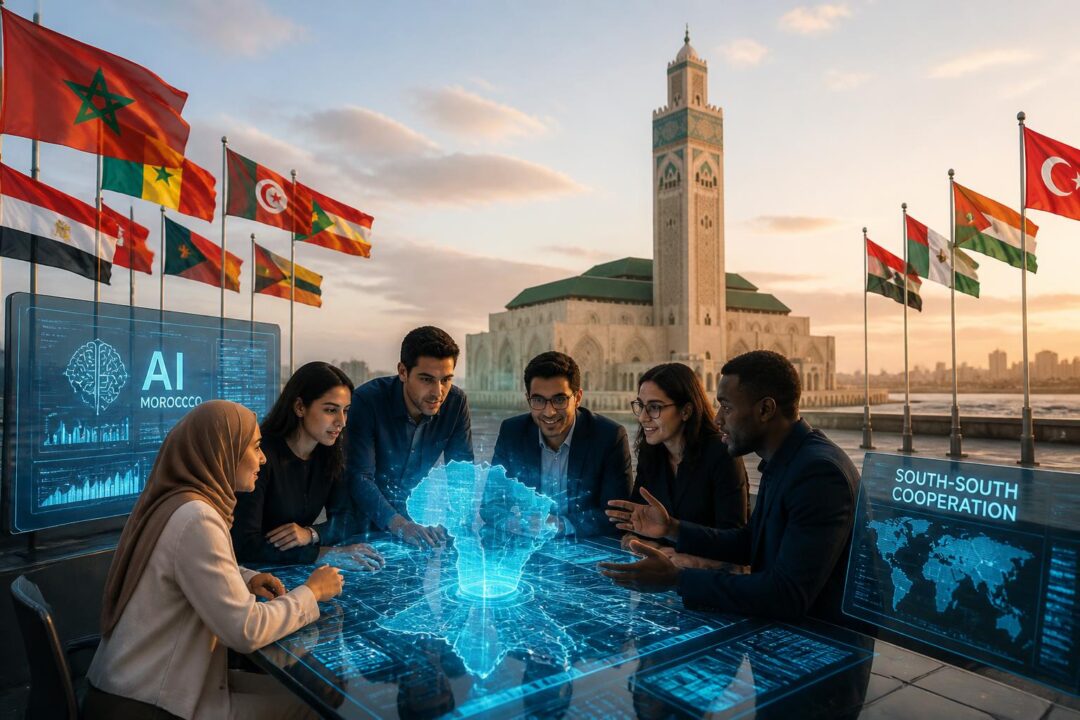
En bref
- 🇲🇦 Made in Morocco devient un label d’Intelligence artificielle pensé pour la souveraineté des données et la crédibilité internationale.
- ☁️ Un cloud souverain (opérationnel depuis 2025) sert de socle à la Transformation digitale de l’État et des secteurs régulés.
- 🤝 La Coopération Sud-Sud est structurée autour de cas d’usage concrets (santé, agriculture, administration) orientés Développement durable.
- 🌍 Le Rayonnement national passe aussi par les enceintes multilatérales, où le Maroc occupe des rôles d’animation sur l’IA et la coopération.
- 🧩 Des Partenariats internationaux (Nord–Sud et triangulaires) accélèrent la recherche, notamment sur la langue arabe et les dialectes.
À Rabat, le lancement de « IA Made in Morocco » a été présenté comme bien davantage qu’un programme de Technologie et d’Innovation. Dans un monde où l’industrialisation de l’Intelligence artificielle redessine les rapports de force, l’initiative revendique une ambition politique et économique: consolider une souveraineté numérique, augmenter la performance des services publics et transformer l’Économie numérique en moteur de compétitivité. L’angle diplomatique n’est pas un supplément d’âme; il constitue un levier assumé de projection et de crédibilité, dans une période où les talents, les brevets, les infrastructures cloud et les investissements privés se concentrent encore massivement dans quelques pôles mondiaux.
Le fil conducteur est clair: bâtir des solutions locales, robustes et réplicables dans d’autres contextes africains, sans tomber dans une dépendance systémique aux grandes plateformes mondiales. Cette logique d’équilibre — souveraineté sans fermeture, ouverture sans naïveté — irrigue les choix d’infrastructure, de formation et de coopération. Le Maroc y voit une opportunité de Rayonnement national, mais aussi une proposition de valeur pour la Coopération Sud-Sud: mutualiser des briques technologiques, partager des compétences et accélérer des usages orientés Développement durable. Derrière l’annonce, une question s’impose: comment passer d’un label à une capacité industrielle, puis à une influence durable?
IA Made in Morocco: souveraineté numérique, cloud souverain et confiance des citoyens
La souveraineté n’est pas un slogan: elle se mesure à la capacité de conserver, traiter et valoriser les données stratégiques sur des infrastructures maîtrisées. Dans l’architecture « Made in Morocco », le cloud souverain opérationnel depuis 2025 joue un rôle de colonne vertébrale. Il répond à un besoin simple, souvent sous-estimé: quand les données de santé, d’identité, de fiscalité ou de justice sortent d’un périmètre de contrôle, la dépendance devient structurelle. Et lorsque la dépendance devient structurelle, toute politique publique numérique perd une partie de sa marge de manœuvre.
Dans les administrations, la Transformation digitale se heurte fréquemment à un obstacle humain: la confiance. Les citoyens acceptent plus facilement une automatisation — prise de rendez-vous, suivi de dossier, identification — lorsqu’ils savent que la gouvernance des données est claire, auditée et conforme. La crédibilité d’une Intelligence artificielle publique dépend alors moins des modèles que des règles: traçabilité, documentation, contrôle des accès, archivage, et capacité à expliquer une décision algorithmique quand elle impacte un droit.
Pour illustrer ce point, imaginons une commune qui déploie un assistant multilingue pour orienter les usagers (arabe, darija, amazigh, français). Si l’outil est hébergé sur une plateforme externe sans cadre strict, la peur de la fuite d’informations (données d’état civil, demandes sensibles) peut bloquer l’adoption. À l’inverse, un hébergement souverain, adossé à des procédures de sécurité, rassure autant les équipes que les usagers. La Technologie cesse d’être perçue comme une boîte noire importée, et devient un service public gouverné.
Ce cadre de confiance implique aussi une culture du risque, particulièrement dans les fonctions RH et la gestion des données personnelles. Les organisations qui intègrent des outils de sélection, de scoring ou d’automatisation administrative doivent anticiper les biais, la sécurité et la conformité. À ce titre, un détour utile consiste à consulter des ressources pratiques sur les risques d’IA appliqués aux données et aux RH, comme les risques IA, RH et données, afin de structurer une gouvernance avant la généralisation.
De la souveraineté à la performance: industrialiser sans rigidifier
Un cloud souverain n’a de valeur que s’il accélère réellement. Les équipes publiques et parapubliques attendent des environnements simples: catalogues de services, API, outils MLOps, et procédures d’achat qui n’étouffent pas l’expérimentation. L’enjeu est de concilier sécurité et vitesse. Un bon indicateur n’est pas seulement la disponibilité technique, mais la capacité à mettre en production un cas d’usage en quelques semaines, avec un suivi continu des performances et des dérives.
Cette exigence rejoint l’objectif de Rayonnement national: un pays ne se raconte pas uniquement par des annonces, mais par des démonstrateurs qui fonctionnent, tiennent la charge, et s’améliorent. La section suivante prolonge ce fil en explorant l’IA comme instrument d’influence et de diplomatie économique.
Rayonnement national: l’IA comme soft power diplomatique et marque de crédibilité
Le Rayonnement national dans l’Économie numérique s’obtient rarement par la taille seule; il se construit par la cohérence d’un modèle. Dans le cas marocain, l’orientation défendue lors du lancement à Rabat articule trois registres: capacité technique, gouvernance éthique et projection diplomatique. Le rôle de l’ambassadeur représentant permanent du Royaume auprès des Nations Unies, Omar Hilale, a consisté à présenter « IA Made in Morocco » comme un outil de souveraineté et de codéveloppement, et pas uniquement comme un produit d’Innovation.
Dans les enceintes multilatérales, le positionnement sur l’IA devient un marqueur de modernité et de sérieux. Lorsqu’un pays copréside des groupes de travail, anime des coalitions ou préside des comités dédiés à la coopération, il façonne des agendas: standards, priorités d’investissement, recommandations en matière d’usage responsable. Cette capacité d’animation compte autant que le code source. Elle transforme la compétence technique en influence normative.
Le contexte mondial rend cette ambition lisible. Les investissements privés en Intelligence artificielle dépassent déjà les 200 milliards de dollars, tandis que l’essentiel des data centers, des brevets et des grands laboratoires reste concentré. Dans ce paysage, l’Afrique est trop souvent cantonnée au rôle de marché de consommation. Un soft power numérique vise précisément à renverser ce schéma: proposer des solutions conçues avec les réalités locales, documentées et gouvernées, puis exportables vers des pays qui partagent des contraintes similaires.
Un exemple concret de soft power se joue dans la langue. Les modèles de traitement automatique de l’arabe et des dialectes sont stratégiques: services publics, centres d’appels, justice, e-santé, éducation. Des Partenariats internationaux ciblés, orientés R&D et transfert de compétences, permettent d’accélérer la création de modèles plus performants, mieux adaptés à la darija et aux usages administratifs. La valeur n’est pas seulement linguistique; elle est souveraine: qui contrôle le modèle contrôle une partie des interfaces du quotidien.
Une diplomatie de la preuve: démonstrateurs, labels et confiance
La diplomatie technologique n’est convaincante que si elle est étayée par des résultats visibles. Cela implique des démonstrateurs audités, des cadres de conformité et une capacité à publier des indicateurs: taux de satisfaction, gains de temps, réduction des erreurs, coûts évités. La crédibilité se bâtit aussi sur la clarté juridique. À cet égard, un rappel utile des principes de transparence, de responsabilité et d’information peut passer par des documents de référence comme les mentions légales d’acteurs qui structurent l’écosystème, afin d’ancrer la pratique numérique dans un cadre explicite.
Cette logique de preuve prépare le terrain à la dimension suivante: faire de l’IA un accélérateur concret de Coopération Sud-Sud, non pas en théorie, mais par des projets qui améliorent la vie quotidienne.
Coopération Sud-Sud: des cas d’usage IA orientés développement durable et services essentiels
La Coopération Sud-Sud gagne en efficacité lorsqu’elle se concentre sur des problèmes partagés: accès aux soins, gestion de l’eau, rendement agricole, urbanisation rapide, formalisation économique. Dans « IA Made in Morocco », l’idée directrice consiste à proposer des solutions adaptées aux contraintes locales — connectivité variable, budgets maîtrisés, diversité linguistique — tout en restant compatibles avec des standards internationaux. Le bénéfice est double: un pays partenaire obtient une solution contextualisée; le Maroc consolide un rôle de hub régional de Technologie et d’Innovation.
Un scénario parlant concerne l’agriculture. Une plateforme d’Intelligence artificielle peut combiner données météo, images satellite et historiques de rendement pour recommander des fenêtres d’irrigation, détecter des stress hydriques ou anticiper certaines maladies. Dans une logique Sud-Sud, l’apport marocain ne se limite pas au modèle: il inclut la méthode de déploiement, la formation des techniciens, et l’intégration dans des coopératives. La valeur se mesure alors en gains de productivité, en eau économisée, et en meilleure stabilité des revenus — trois ingrédients du Développement durable.
Dans la santé, les usages les plus responsables se situent souvent dans l’aide à la décision et le triage, plutôt que dans la substitution totale. Un service d’orientation basé sur symptômes, langues locales et données épidémiologiques peut réduire la saturation des urgences, surtout lorsque les populations hésitent à se déplacer. La clé est de maintenir l’humain dans la boucle: l’IA propose, le professionnel valide. Cette approche inclusive évite le fantasme du remplacement et renforce l’acceptabilité.
Pour rendre ces projets réplicables, une discipline s’impose: définir des kits de déploiement (données minimales, matériel requis, guides de gouvernance, métriques). La coopération devient pragmatique lorsqu’elle propose des « briques » plutôt que des discours. Une liste d’ingrédients revient fréquemment dans les projets qui réussissent:
- 🧭 Définition précise du problème (éviter les projets “vitrine” sans usage clair).
- 🧪 Jeux de données documentés, avec consentement et règles de conservation.
- 🏗️ Infrastructure dimensionnée (cloud souverain ou hybride selon les contraintes).
- 👩🏫 Transfert de compétences (formation, coaching, support en production).
- ⚖️ Gouvernance éthique (biais, explicabilité, recours, audit).
- 📈 Indicateurs d’impact liés aux ODD: délais, coûts, qualité, inclusion.
Coopération triangulaire: Nord, Maroc, Sud global
La coopération la plus efficace est souvent triangulaire: expertise du Nord sur certaines briques (outillage, recherche fondamentale), compétences marocaines d’intégration et de contextualisation, bénéfice direct pour des partenaires africains. Avec l’appui d’organisations internationales, cette mécanique évite deux écueils: l’importation “clé en main” sans transfert, et l’isolement technologique. La section suivante s’intéresse justement à la manière de structurer l’écosystème — talents, instituts, entreprises — pour rendre ce modèle soutenable.
Économie numérique: structurer l’écosystème IA, des talents aux instituts et aux entreprises
Un programme national d’Intelligence artificielle ne tient pas sur une annonce; il tient sur une chaîne de valeur: formation, recherche, industrialisation, adoption par les métiers, exportation. L’ambition « Made in Morocco » suppose donc une politique de talents et une gouvernance des compétences. Dans la réalité des organisations, une transformation réussie se joue souvent dans les profils hybrides: data engineers capables de sécuriser les pipelines, product owners qui comprennent les contraintes métiers, juristes data, et responsables RH à l’aise avec les enjeux d’équité et de conformité.
Le développement d’instituts spécialisés — à l’image des initiatives de type “institutes” dédiés à l’IA — répond à un besoin d’industrialisation du savoir. Un institut efficace ne se contente pas de publier; il opère des plateformes de données, héberge des challenges, standardise des pratiques MLOps et met en relation entreprises, administrations et laboratoires. L’enjeu est aussi territorial: connecter Rabat, Casablanca, Tanger, Fès, Marrakech, mais également des pôles plus émergents, afin d’éviter une concentration des opportunités.
Une anecdote typique, observée dans de grands groupes, illustre l’importance des métiers. Une entreprise fictive, “AtlasLog”, opérateur logistique, décide de réduire les retards de livraison. Le premier réflexe est d’acheter un outil “intelligent”. Le projet stagne. La bascule intervient lorsqu’un binôme métier-data cartographie les goulots (créneaux portuaires, disponibilité chauffeurs, ruptures de charge), puis entraîne un modèle sur des données propres. L’IA devient utile parce que l’organisation a clarifié la responsabilité: qui alimente la donnée, qui valide les recommandations, qui arbitre quand le modèle se trompe? C’est précisément ce type de rigueur qui fait passer l’Innovation du prototype au résultat.
| Levier 🧩 | Objectif 🎯 | Exemple d’application au Maroc 🇲🇦 | Impact attendu 📊 |
|---|---|---|---|
| Cloud souverain ☁️ | Maîtrise des données stratégiques | Hébergement de services publics sensibles | Confiance, conformité, continuité |
| Talent pipeline 🎓 | Former et retenir des profils IA | Programmes de montée en compétences pour administrations/entreprises | Projets plus rapides, meilleure qualité |
| Langues locales 🗣️ | Interfaces accessibles et inclusives | Modèles pour arabe, darija, amazigh | Adoption massive, réduction de la fracture numérique |
| Gouvernance éthique ⚖️ | Réduire biais et risques | Comités d’évaluation, audits, procédures de recours | Décisions plus justes, acceptabilité sociale |
| Export de solutions 🌍 | Coopération et influence | Projets réplicables en Afrique (santé, agriculture, e-gov) | Coopération Sud-Sud renforcée |
Un cap opérationnel: mesurer la valeur, pas seulement l’activité
Dans les écosystèmes matures, l’IA est évaluée par l’impact: temps gagné, erreurs évitées, satisfaction usager, coûts réduits, accès amélioré. Les indicateurs d’activité (nombre de POC, hackathons) ne suffisent plus. Pour ancrer cette logique, un outil de cadrage peut aider à prioriser les projets selon leur valeur publique, leur faisabilité et leur risque.
Tableau comparateur interactif — Prioriser des projets d’IA au Maroc
Ajustez les paramètres, triez, filtrez, puis exportez vos résultats. Les scores vont de 0 à 100.
Paramètres de calcul
Personnalisez le poids de chaque critère (la somme est normalisée automatiquement).
Plus le risque est élevé, plus le score final diminue (si ce poids est > 0).
Exigence forte de souveraineté = mise en œuvre plus complexe (pénalité si poids > 0).
Effort de formation élevé = déploiement plus long (pénalité si poids > 0).
Recherche & filtres
Recommandation automatique
Basée sur les poids actuels et le classement recalculé.
Note : les pénalités (éthique, souveraineté, formation) réduisent le score. Vous pouvez les désactiver en mettant leur poids à 0.
Tableau comparatif
Conseil : cliquez sur une ligne pour afficher un résumé. Le tableau est défilable si nécessaire.
| Projet (tri) | Valeur pour le service public (0–100) | Faisabilité données/infrastructure (0–100) | Risques éthiques (0–100) | Niveau de souveraineté requis (0–100) | Effort de formation (0–100) | Score final (0–100) |
|---|
Résumé du projet sélectionné
Cliquez une ligne du tableau pour mettre à jour ce panneau.
Aide à la lecture
- Valeur et Faisabilité augmentent le score.
- Risques éthiques, Souveraineté et Formation sont des pénalités.
- Vous pouvez adapter les poids selon un contexte : service public, urgence, budget, maturité des données.
Astuce : si vous préparez une coopération Sud-Sud, augmentez le poids « Valeur » et réduisez la pénalité « Souveraineté » pour favoriser des solutions réplicables.
Réduit l’espace vertical pour une meilleure intégration dans l’article.
Une fois l’écosystème consolidé, l’étape critique consiste à sécuriser les alliances externes: la section suivante détaille comment les Partenariats internationaux peuvent accélérer sans diluer la souveraineté.
Partenariats internationaux: accélérer l’innovation tout en préservant souveraineté et éthique
Les Partenariats internationaux sont indispensables dans une discipline où les cycles technologiques sont rapides et la recherche coûteuse. L’enjeu consiste à choisir des partenariats qui transfèrent réellement des capacités: co-développement, co-publications, formation, accès à des outils avancés, et non simple consommation de services. Dans l’approche « IA Made in Morocco », la coopération avec des leaders technologiques peut porter sur des briques précises — traitement automatique des langues, sécurité, outillage MLOps, optimisation d’infrastructures — à condition d’encadrer les données, la propriété intellectuelle et les modalités d’audit.
La notion d’IA éthique et inclusive devient ici très concrète. Un système de recommandation pour l’emploi, par exemple, peut reproduire des discriminations si les données historiques reflètent des biais. Un modèle de scoring de risque, s’il est déployé sans explicabilité, peut priver un usager de recours. Ces problématiques ne se règlent pas “après”, mais au moment de la conception: documentation des jeux de données, tests de biais, mécanismes d’appel, et gouvernance partagée.
Dans les grandes organisations, le réflexe consiste souvent à déléguer la vigilance au juridique. Or, une gouvernance solide associe RH, DSI, conformité, métiers et partenaires. La politesse institutionnelle n’empêche pas la fermeté contractuelle: exigences d’hébergement, clauses d’audit, limites d’usage des données, et obligation de former des équipes locales. Sans cela, la Transformation digitale risque de se transformer en dépendance, ce qui contredirait l’objectif de Rayonnement national.
Un partenariat utile se reconnaît aussi à ses livrables: création de modules de formation certifiants, laboratoires conjoints, benchmarks publics, et guides de déploiement. Le tout doit servir une trajectoire: faire émerger des champions locaux, renforcer les PME innovantes, et permettre à des administrations d’acheter des solutions “prêtes à l’échelle” plutôt que de multiplier des prototypes.
Vers une doctrine exportable: souveraineté ouverte et codéveloppement
La force d’un modèle réside dans sa capacité à être expliqué, transmis et adapté. Une doctrine marocaine d’IA, combinant cloud souverain, cas d’usage orientés Développement durable, gouvernance éthique et coopération triangulaire, constitue une proposition lisible pour le Sud global. À l’heure où l’IA reconfigure les chaînes de valeur, cette lisibilité devient un avantage stratégique: elle attire des projets, des talents, et une confiance durable.
Que recouvre exactement le label « IA Made in Morocco » ?
Il s’agit d’une approche visant à développer des solutions d’Intelligence artificielle conçues et gouvernées au Maroc, avec un accent sur la souveraineté des données (notamment via un cloud souverain), l’éthique et l’adaptation aux besoins locaux, tout en restant ouverte aux partenariats internationaux.
Pourquoi le cloud souverain est-il central dans cette stratégie ?
Parce qu’il permet de garder sous contrôle national les données sensibles (administration, santé, services régulés) et d’établir une base de confiance pour la Transformation digitale. Il aide également à réduire certaines dépendances technologiques et à industrialiser les déploiements.
Quels domaines sont prioritaires pour la Coopération Sud-Sud en IA ?
Les secteurs à impact rapide et mesurable: santé (triage et orientation), agriculture (irrigation, prédiction de stress hydrique), services publics (assistants multilingues), gestion des ressources (eau, énergie) et éducation. L’objectif est de produire des solutions réplicables et alignées sur le Développement durable.
Comment éviter que l’IA aggrave les inégalités ou les biais ?
En intégrant une gouvernance éthique dès la conception: tests de biais, explicabilité, audits, documentation des données, mécanismes de recours, et maintien d’un contrôle humain pour les décisions à fort impact. La formation des équipes métiers est aussi déterminante.
Que doivent exiger les organisations lors de Partenariats internationaux en IA ?
Des transferts réels de compétences (formation, co-développement), des clauses de souveraineté et d’audit, une gouvernance des données explicite, et des livrables concrets (outillage, référentiels, documentation). Un partenariat réussi renforce l’Économie numérique locale au lieu de créer une dépendance.

Benjamin Le Goff, redacteur en chef et fondateur, ancien consultant en strategie RH passe par les grands cabinets internationaux. Specialiste du tissu economique marocain et observateur attentif des transformations sociales qui touchent les cols blancs comme les ouvriers du Royaume, Benjamin publie chaque semaine une enquete, une analyse de fond ou une interview de DRH ou de dirigeant. La ligne editoriale assume sa subjectivite : rigueur factuelle, sources verifiables et zero complaisance commerciale.