Understanding the Role of ORMVAM in 2025: Water Governance and Agricultural Development
The ORMVAM, Regional Office for Agricultural Development of the Moulouya, holds a strategic position in the Moroccan agricultural ecosystem. In 2025, its action is positioned at the intersection of water management, valorization of irrigated lands, and socio-economic support for farmers. The Moulouya, an emblematic basin of the North-East, concentrates high value-added crops (citrus, market gardening) and thousands of direct and indirect jobs. Coordination between hydraulic infrastructures, territorial planning, and local services becomes essential to cope with water scarcity and market fluctuations.
In this region, the primary mission is not limited to conveying water. It consists in arbitrating between uses, optimizing available volumes, and strengthening natural resource preservation. The irrigated perimeter, constructed between the 1950s and 1960s, enabled the development of vast plains. But the silting up of reservoirs, erosion, and leaks now require deep modernization. The ORMVAM role thus becomes broader: technical, economic, and social, with a strong anchoring in the national environmental policy.
Farmers expect concrete and rapid answers. In Berkane, for example, a group of operators has rationalized its irrigation slots thanks to rotating schedules proposed by the Office. Result: fewer losses, better sizing of clementines, and controlled energy costs. This type of coordination embodies the spirit of public service expected of a network manager serving the territory.
Key Functions and Efficiency Drivers
To clarify responsibilities, it is useful to distinguish four structuring functions. The first, hydraulic engineering, focuses on canals, stations, and gates. The second concerns technical support to crops and orientation towards localized irrigation. The third deals with collective organization (water schedules, shared maintenance). The fourth touches on economic inclusion: training, access to climate insurance, and the emergence of cooperatives, notably women’s cooperatives.
- 🚰 Water management: balancing allocations between sectors and seasons.
- 📊 Performance monitoring: indicators of water efficiency and network quality.
- 🌱 Sustainable development: water-saving practices and protected soils.
- 🤝 Proximity: service desks, mediation, and ongoing information.
This network of actions is consistent with national orientations. Regional Offices plan for 2025-2027 a cumulative investment effort announced at 11.23 billion dirhams, continuing the conversion to localized irrigation already covering 276,032 ha, or about 41% of the irrigated network. In the Moulouya, the concrete translation is the modernization study of the open-air network supplied from the Mechraâ Hammadi dam. This articulation of policies and projects strengthens the ORMVAM 2025 impact beyond the sole canal perimeter.
| ORMVAM Function 🎯 | Key Objective ✅ | Practical Indicator 📈 | Field Example 🌍 |
|---|---|---|---|
| Hydraulic engineering | Reduce losses and ensure delivery reliability | Linear losses (m³/km) 📉 | Targeted rehabilitation of old sections |
| Support to crops | Maximize yield per m³ of water | Water productivity (kg/m³) 🌾 | Drip irrigation on Berkane citrus |
| Collective organization | Plan water rotations and maintenance | Compliance rate with slots ⏱️ | Shared schedules by sector |
| Economic inclusion | Train and secure income | Climate insurance (ha covered) ☂️ | Extended coverage in orchards |
Overall coherence – technical, social, and environmental – conditions the sustainability of crops and local employment. It is this tripod that confers its uniqueness to the Office’s action in the Moulouya region.

ORMVAM Missions and Modernization of the Moulouya Network: 66,000 ha to Secure
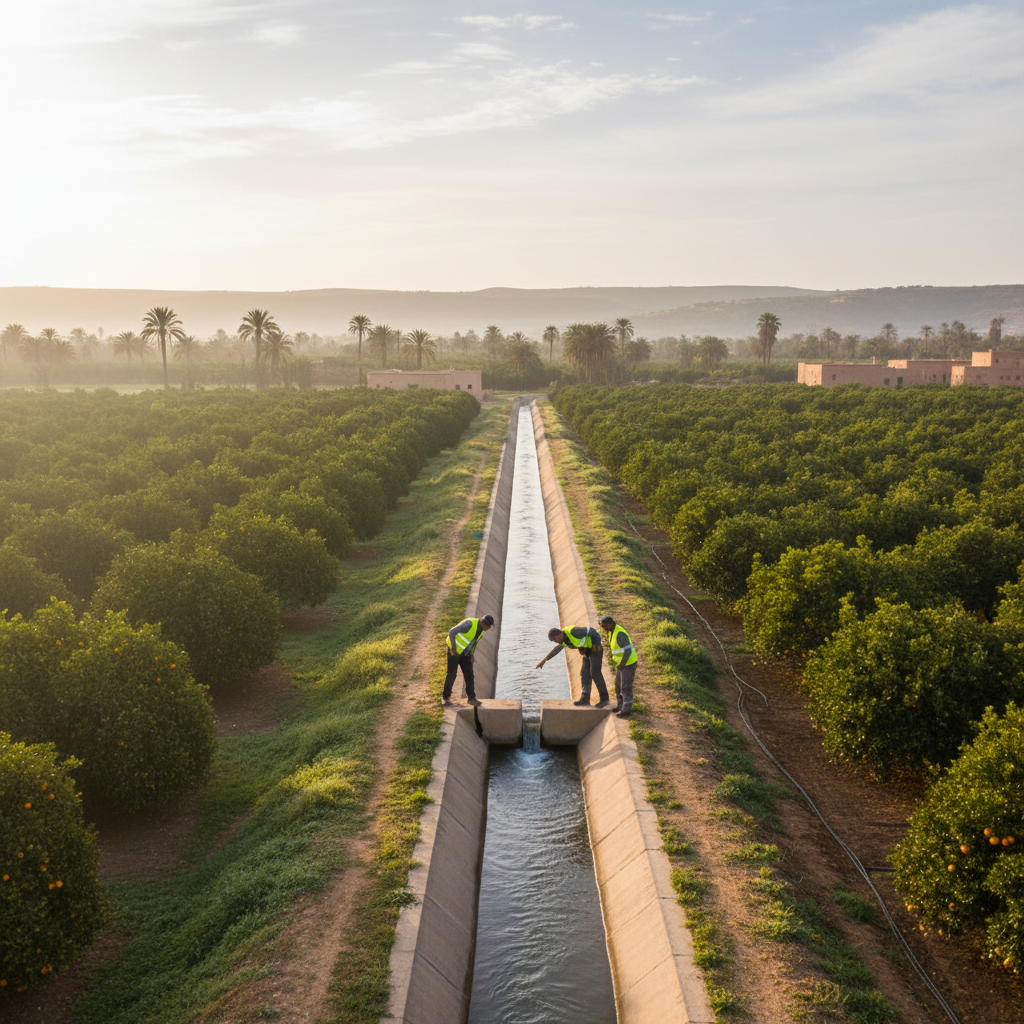
At the heart of ORMVAM missions is the modernization of irrigation infrastructures. Faced with the deterioration of segments built between 1950 and 1960, the Office is launching a strategic study covering more than 66,000 hectares in the provinces of Berkane, Nador, and Taourirt. The objective is clearly defined: optimize delivery, reduce losses, and increase the perimeter’s resilience to hydrological variability. Two arteries structure the system: the main canal Right Bank (RD) about 155 km long (initial head flow of 18 m³/s) and the main canal Left Bank (RG) about 133 km long (17 m³/s). Open-air, in trapezoidal section and lined with heterogeneous materials, these canals suffer silting originating from a highly erodible watershed.
The timeline is precise. A study estimated at just over 4 million dirhams must establish the optimal scenario: targeted rehabilitation of damaged structures, partial modernization with advanced regulation, or complete overhaul with measurement and control technologies. This approach includes a modern methodological arsenal: 3D scanning, geophysical and geotechnical surveys, alkali-reaction tests, sonic inspections, and concrete resistance tests. Local consultations will incorporate irrigator constraints and crop specificities.
Why Act Now? Challenges, Risks, and Solutions
Diagnostics converge: reservoir silting, aggravated by erosion of the Moulouya basin, requires frequent draining which weakens the linings. Leaks and unregulated withdrawals increase losses and disrupt distribution. Without intervention, water efficiency deteriorates, endangering hundreds of farms. Conversely, well-designed modernization creates a virtuous circle: more useful water, stabilized yields, and reduced maintenance costs.
- 🛠️ Targeted rehabilitation: repair critical sections for quick gains.
- 📡 Smart regulation: sensors, motorized gates, and supervision.
- 🔁 Complete overhaul: reprofile, seal, and equip with remote management.
- 🧩 Consultation: integrating the opinions of farmers from Berkane, Nador, Taourirt.
An example illustrates the interest of a progressive approach. In a downstream sector of Taourirt, the punctual replacement of a cracked section, coupled with valve recalibration, halved measured losses over 4 km. At a larger scale, such gains translate into thousands of cubic meters saved each campaign, re-injected towards end-of-rotation crops.
| Network Element 🧱 | Current State/Risk ⚠️ | Envisioned Solution 🛠️ | Expected Benefit 🌟 |
|---|---|---|---|
| Canal RD (155 km) | Leaks, aging lining | Rehabilitation of critical sections | Fewer losses, stable flow |
| Canal RG (133 km) | Recurring silting | Dredging + threshold improvement | Increased hydraulic stability |
| Intake structures | Obsolete controls | Progressive automation | Real-time responsiveness |
| Reservoirs | High sedimentation | Sediment management + protections | Fewer drainings, longer lifespan ↑ |
This modernization, based on national environmental policy standards, supports adaptation to climate change. The gained water efficiency secures the citrus campaign, essential for Oriental exports. It is also a major attractiveness lever for young agricultural entrepreneurs.
By enhancing network reliability, the Office strengthens the confidence of sectors and visibility of private investments. This type of public-private alignment transforms technical modernization into a regional competitive advantage.
ORMVAM 2025 Impact on Employment, Cooperatives, and Sectors of the Moulouya
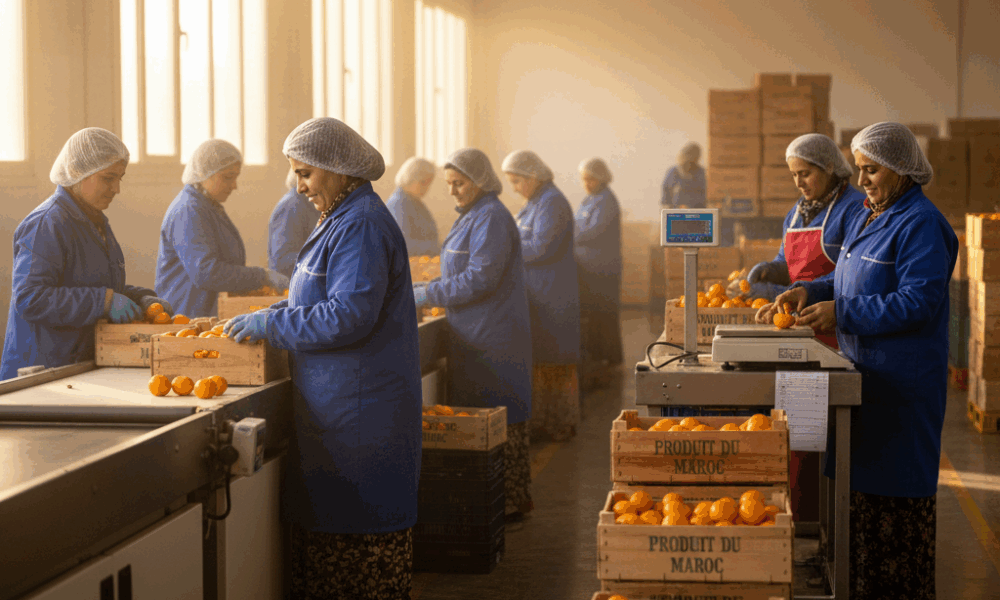
The ORMVAM 2025 impact goes beyond the canal framework. Benefits are measured in local employment, growth of cooperatives, and increased operator skills. In Berkane, the citrus sector remains a pillar, with robust production forecasts and a significant share destined for export, notably for clementine varieties. When water is better managed, sizing and coloration improve, and premium outlets expand. Women’s cooperatives, encouraged by national and international programs, strengthen their resilience to climatic and economic shocks.
Figures confirm the inclusive dynamic. Social coverage has recently benefited nearly 416,439 farmers, while climate insurance has been extended to about 254,349 ha, well on track towards the 2030 goal. Access to these schemes changes the game for small vulnerable farms. In Nador, for example, a mixed cooperative has set up an emergency fund funded by a subsidized insurance premium and a micro-equipment (humidity sensors) co-financed with the Office: a safety net that avoids selling at a loss during dry seasons.
Local Skills, Employment, and Knowledge Transfer
Network optimization calls for varied profiles: facility operators, maintenance technicians, remote management specialists, agronomists. Rehabilitation sites generate temporary jobs, while modernized management creates sustainable skilled positions. A typical pathway emerges for young graduates of applied technology institutes: internship in an irrigation sector, then taking control of a batch of valves, before moving to performance indicator analysis.
- 🧑🏭 Technical jobs: dredging, repair, instrumentation.
- 🧑💻 Digital professions: remote measurement, GIS, supervision.
- 👩🌾 Crop services: fertigation, integrated pest management.
- 🧑⚖️ Local governance: water committees, mediation, training.
The trajectory of “Amina,” a farmer in Ahfir, illustrates the value of support. After training on localized irrigation and fertilization, her clementine plot recorded a 15% yield gain for a 20% reduced water volume. This differential funded her cooperative’s membership in a quality certification, opening access to export contracts.
| Socio-Economic Dimension 🤝 | Measurable Effect 📌 | ORMVAM Tool 🧰 | Market Signal 💹 |
|---|---|---|---|
| Local employment | Worksites and skilled positions | Work contracts + training | Reduction of seasonal unemployment |
| Cooperatives | Cost sharing | Dedicated support programs | Product range upgrading |
| Insurance | Stabilized income | Coverage extension ☂️ | Facilitated private investments |
| Export | Stable sizing and quality | Reliable water schedules | Access to premium markets 🌍 |
By strengthening safety nets and competitiveness, the Office connects hydraulic engineering to social mobility. This link, when maintained, retains talents and stabilizes rural territories of the Moulouya.
Water Management, Territorial Planning, and Environmental Policy in the Moulouya
The success of modernization relies on water management integrating the resource, uses, and space. Territorial planning acts as a compass: it organizes production zones, hydraulic corridors, agricultural tracks, and protection zones. Climate change adaptation requires scenarios per season, alert thresholds, and real-time adjustment capacity. ORMVAM translates this vision into practical rules: water rotations, sediment alerts, maintenance priorities, and user education.
The regional environmental policy is not limited to water. It concerns soils, useful biodiversity, and fertilization practices to limit salinity and diffuse pollution. In the clay-loam plains of the Moulouya, overly generous irrigation management leads to saline rises. Conversely, precise dosing, coupled with vegetative cover, improves soil structure and medium-term productivity. These finely balanced compromises ensure natural resource preservation.
Digital Tools, Water Governance, and Consultation
The Office increasingly relies on digital technology: geographic information systems, level sensors, dashboards, turbidity alerts. Local committees participate in decisions through thematic meetings. For example, a “clean restart” protocol post-draining limits sediment influx in downstream sections, thanks to progressive flow sequencing. Education among irrigators is decisive to respect these technical windows.
- 🛰️ GIS mapping: identify network weak points.
- 📲 Remote measurement: monitor levels and turbidity.
- 🧪 Water quality: control salinity and sediments.
- 🗺️ Planning: align crops, water, and logistics.
| Tool/Process 🛎️ | Operational Use ⚙️ | Stakeholders 👥 | Expected Outcome 🌱 |
|---|---|---|---|
| GIS + sensors | Locate leaks, operate valves | ORMVAM, user associations | Responsiveness and water savings |
| Water committees | Arbitrate turns, resolve conflicts | Farmers, municipalities | Social adherence, equity 🤝 |
| Sediment protocols | Dredging, progressive start-up | Technicians, operators | Less clogging, durability |
| Best practices | Fertigation, cover crops | Advisors, cooperatives | Living soils, stable yields |
This broadened approach makes the irrigation network a truly living system, where each adjustment produces chain effects. It is also a collective learning ground that strengthens user autonomy.
By integrating technology, consultation, and good agronomic practices, the Moulouya sets a credible path to secure Moroccan irrigated agriculture in a hydrologically more uncertain era.
Investments 2025-2027, Innovation and Governance: The Development Roadmap
The investment trajectory announced for the Regional Offices – 11.23 billion MAD by 2027 – reflects the scale of ambition. In the Moulouya, the effort prioritizes hydraulic reliability, expansion of localized irrigation, and support for sectors. The 276,032 ha already converted to drip irrigation, or 41% of the irrigated network, indicate a structural transition. ORMVAM aligns these projects with the national sustainability dynamic and concrete needs of farmers.
Financing combines public budgets, international grants, and private co-financing. Clarity of indicators is essential: m³ saved, linear meters rehabilitated, water productivity, insured surfaces, jobs created. Governance is thus strengthened as results become comparable between sectors and campaigns. A monitoring committee includes representatives of operators, ensuring territorial anchoring of decisions.
Heading Towards Useful and Measurable Innovation
Innovation is not an end in itself. It must address an identified problem and prove its effectiveness. Priorities: simple and robust sensors, evolving remote management, adapted anti-sediment solutions, short and targeted training. Demonstrations on pilot plots reassure and accelerate adoption. A sharing platform, fueled by feedback from Amina and other farmers, can reduce implementation errors and harmonize practices.
- 💧 Optimized drip irrigation: less water, same yield.
- 🧠 Useful data: simple, visible, actionable indicators.
- 🔧 Preventive maintenance: reduce breakdowns and costs.
- 📚 Flash trainings: 2-3 hours, one technical gesture at a time.
| Strategic Component 🧭 | Priority Action 🚀 | Monitored KPI 📊 | Economic Effect 💼 |
|---|---|---|---|
| Hydraulics | Rehabilitate X km/year | Linear meters rehabilitated 🛠️ | Lower water cost/m³ |
| Localized irrigation | Equip fragile sectors | Ha converted 🌱 | Higher value/ha |
| Insurance | Extend coverage | Ha insured ☂️ | Stabilized income |
| Training | Targeted sessions | Participants trained 👩🏫 | Fewer errors, higher yield |
By keeping focus on tangible results, the 2025-2027 roadmap can convert every dirham invested into productive and social benefit for the Moulouya and its sectors.
From Technique to Competitiveness: How ORMVAM Anchors Sustainable Development
Hydraulic transformation only makes sense if it translates into durable gains for farmers. Sustainable development becomes here the condition for competitiveness. Reducing water losses, protecting soils, and stabilizing irrigation schedules support farm margins and product quality. For recruiters in the Moroccan agri-food sector, this stability translates into sustainable needs for technical profiles and logistical skills.
International markets demand traceability and regularity. By ensuring reliable flow until plots, the Office facilitates harvest planning and compliance with export contracts. This institutional asset attracts investments and secures local employment. Known for its clementines, the Moulouya can thus diversify its offer – juices, segments, processed products – and foster the emergence of downstream SMEs.
Value Chain, Attractiveness, and Resilience
Canal modernization acts as a multiplier. It reduces upstream uncertainties and unleashes downstream value. During water stress periods, better-equipped farms maintain steady production levels, stabilizing supply and prices. For young graduates, the region becomes a field of expertise: network supervision, irrigation project management, consultancy in fertigation and energy efficiency.
- 🏭 Agro-industry: stable volumes, homogeneous quality.
- 🚚 Logistics: facilitated planning, fewer disruptions.
- 🧑🎓 Skills: water and agronomy professions in demand.
- 🌍 Territorial image: pioneer basin in climate adaptation.
| Sustainable Pillar ♻️ | Concrete Action 🧩 | Measured Impact 📐 | Employment Signal 👔 |
|---|---|---|---|
| Water | Reduce leaks and sediments | M³ saved 💧 | Network technicians |
| Soil | Cover crops and guided fertigation | OM/ha and structure 🌱 | Agronomist advisors |
| Climate | Insurance and resilient varieties | Ha insured ☂️ | Agricultural support agents |
| Governance | Water committees and transparency | Compliance rate 📑 | Territorial mediators |
This dynamic links technology and human factors, upstream agriculture and downstream industry. In sum, it transforms water management into a competitive advantage and social mobility for the Moulouya.
{“@context”:”https://schema.org”,”@type”:”FAQPage”,”mainEntity”:[{“@type”:”Question”,”name”:”What is ORMVAM and what are its priorities in 2025?”,”acceptedAnswer”:{“@type”:”Answer”,”text”:”ORMVAM is the Regional Office for Agricultural Development of the Moulouya. Its 2025 priorities focus on the modernization of the irrigation network (66,000 ha), reduction of water losses, support to sectors (notably citrus), and inclusion through training and climate insurance.”}},{“@type”:”Question”,”name”:”Why modernize the RD and RG canals of the Moulouya?”,”acceptedAnswer”:{“@type”:”Answer”,”text”:”Built between 1950 and 1960, they present leaks, silting, and obsolete equipment. Their rehabilitation improves water efficiency, stabilizes yields, and secures local employment.”}},{“@type”:”Question”,”name”:”What benefits do farmers gain with localized irrigation?”,”acceptedAnswer”:{“@type”:”Answer”,”text”:”Significant water savings, better irrigation uniformity, more precise fertigation, and improved harvest quality, favorable for local and export markets.”}},{“@type”:”Question”,”name”:”How does ORMVAM integrate climate change adaptation?”,”acceptedAnswer”:{“@type”:”Answer”,”text”:”Through territorial planning, network remote monitoring, extension of climate insurance, agroecological practices, and prioritization of high water-impact investments.”}},{“@type”:”Question”,”name”:”What employment opportunities does modernization create?”,”acceptedAnswer”:{“@type”:”Answer”,”text”:”Technical positions (dredging, maintenance), digital (remote measurement, GIS), agronomic (advisory, fertigation), and local governance (water committees, mediation).”}}]}What is ORMVAM and what are its priorities in 2025?
ORMVAM is the Regional Office for Agricultural Development of the Moulouya. Its 2025 priorities focus on the modernization of the irrigation network (66,000 ha), reduction of water losses, support to sectors (notably citrus), and inclusion through training and climate insurance.
Why modernize the RD and RG canals of the Moulouya?
Built between 1950 and 1960, they present leaks, silting, and obsolete equipment. Their rehabilitation improves water efficiency, stabilizes yields, and secures local employment.
What benefits do farmers gain with localized irrigation?
Significant water savings, better irrigation uniformity, more precise fertigation, and improved harvest quality, favorable for local and export markets.
How does ORMVAM integrate climate change adaptation?
Through territorial planning, network remote monitoring, extension of climate insurance, agroecological practices, and prioritization of high water-impact investments.
What employment opportunities does modernization create?
Technical positions (dredging, maintenance), digital (remote measurement, GIS), agronomic (advisory, fertigation), and local governance (water committees, mediation).

Comments are closed