Chinese pressure on fertilizers and Moroccan redeployment: strategic reading for 2025
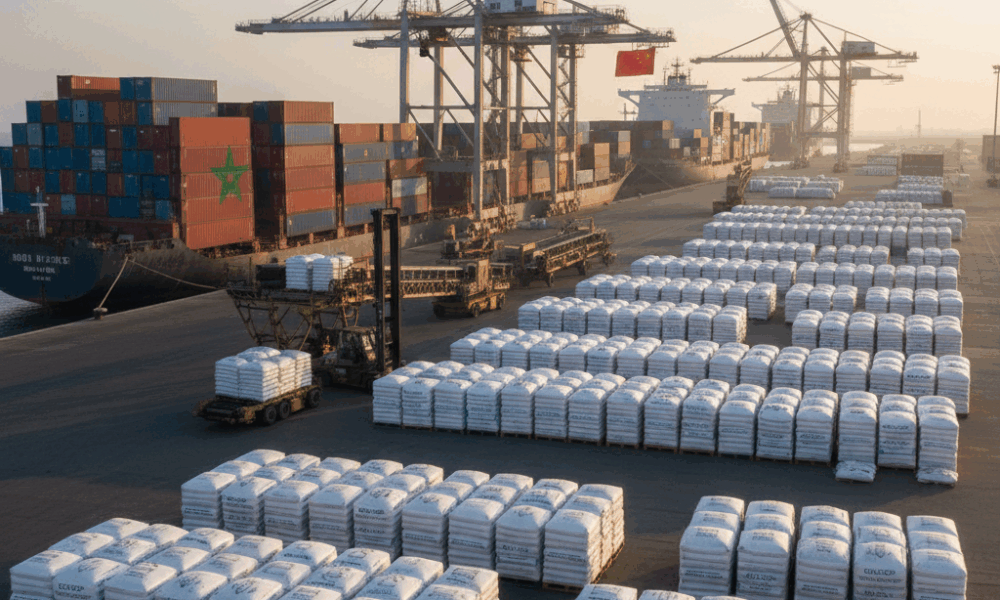
The Chinese pressure on fertilizer flows is disrupting the balances of international trade. After a gradual reduction in DAP shipments starting in 2023, the almost complete halt to India at the beginning of the year forced several actors to reconfigure their supply. For Morocco, holder of about 70% of the world’s phosphate reserves, the window is clear: increase its adjustment capacity and secure long-term outlets.
The Moroccan strategy relies on OCP and its subsidiary OCP Nutricrops, which concluded a comprehensive agreement with six Indian partners covering 2.5 million tons, expected to reach 2.8 to 3 million tons. The objective is twofold: meet demand while limiting exposure to price shocks and export restrictions. This configuration strengthens the Kingdom’s role as a pivot between Africa, Asia, and Europe.
This turnaround is part of a broader sequence where natural resources are instrumentalized. China’s contraction of rare earth exports signaled the market about the risk of excessive dependence. Buyers are now looking for reliable suppliers capable of delivering regular volumes and co-investing in sustainability and agronomic performance.
Morocco benefits from solid fundamentals: vertical integration from mine to plant, logistical intensification, and support for farmers through responsible fertilization. Imports of complementary inputs, control of energy costs, and port modernization reinforce this stature. The challenge is to transform a geological advantage into a sustainable competitive advantage.
In this context, high value-added qualified employment — process engineering, maintenance 4.0, data for soil weather — becomes a key lever. Companies featured in the 2025 best employers panorama focus on these professions to retain talent. The ability to train and retain skills is part of the sovereignty equation.
On the geoeconomic level, this reorientation confirms the rise of an economic competition focused on input security. Importing countries secure multi-year contracts, multi-port logistics options, and decentralized storage capacities. The credibility of agreements relies on transparency, on-time delivery, and agronomic innovation.
On the regional stage, the ripple effect can benefit West Africa thanks to optimized maritime corridors and the extension of precision agriculture solutions. Morocco, already at the heart of structuring development dossiers, reaffirms its place as a stable player, as various analyses on economic and territorial balances suggest.
What to watch in the coming months
- 🔎 Price volatility of phosphates and buyer arbitrations.
- 🚢 Evolution of export constraints in Asia and the Middle East.
- 🧪 Accelerated adoption of effective formulations (TSP, DAP) in targeted countries.
- 🤝 New industrial alliances and co-investments in logistics.
- 📊 Indicators of qualified employment and rise in local skills.
| Key variable 🌍 | Trend 2025 📈 | Impact for Morocco 🇲🇦 |
|---|---|---|
| China-India DAP flows | Stop / constraint | Window for Moroccan exports |
| OCP Nutricrops contracts | 2.5 → 2.8-3 Mt | Customer demand stability 🤝 |
| Energy prices | Moderate volatility | Pressure on margins, gain through efficiency ⚙️ |
| Agronomic innovation | Acceleration | Product and service differentiation 🧪 |
The upcoming sequence will revolve around contractual credibility, logistics, and innovation, three pillars where Morocco has built a tangible operational advantage.

Strengthened supplies and port logistics: securing domestic and regional demand
The robustness of supplies depends on the port logistics chain. Morocco has reorganized its import and export flows through a finer distribution between main and secondary ports. This logic, tested on cereals, inspires fertilizer shipping schemes.
The drought–inflation conjunction has reminded of the fragility of regional stocks. The country has increased the use of buffer storage capacities and strengthened railway links between industrial sites and terminals. Gains are measured in turnaround times, unit costs, and service regularity.
Actors in the HR, logistics, and industry chain coordinate their talent needs. Departments featured in rankings such as the 2025 employer directory invest in port security training, planning, and maintenance. Operational quality becomes a competitive advantage.
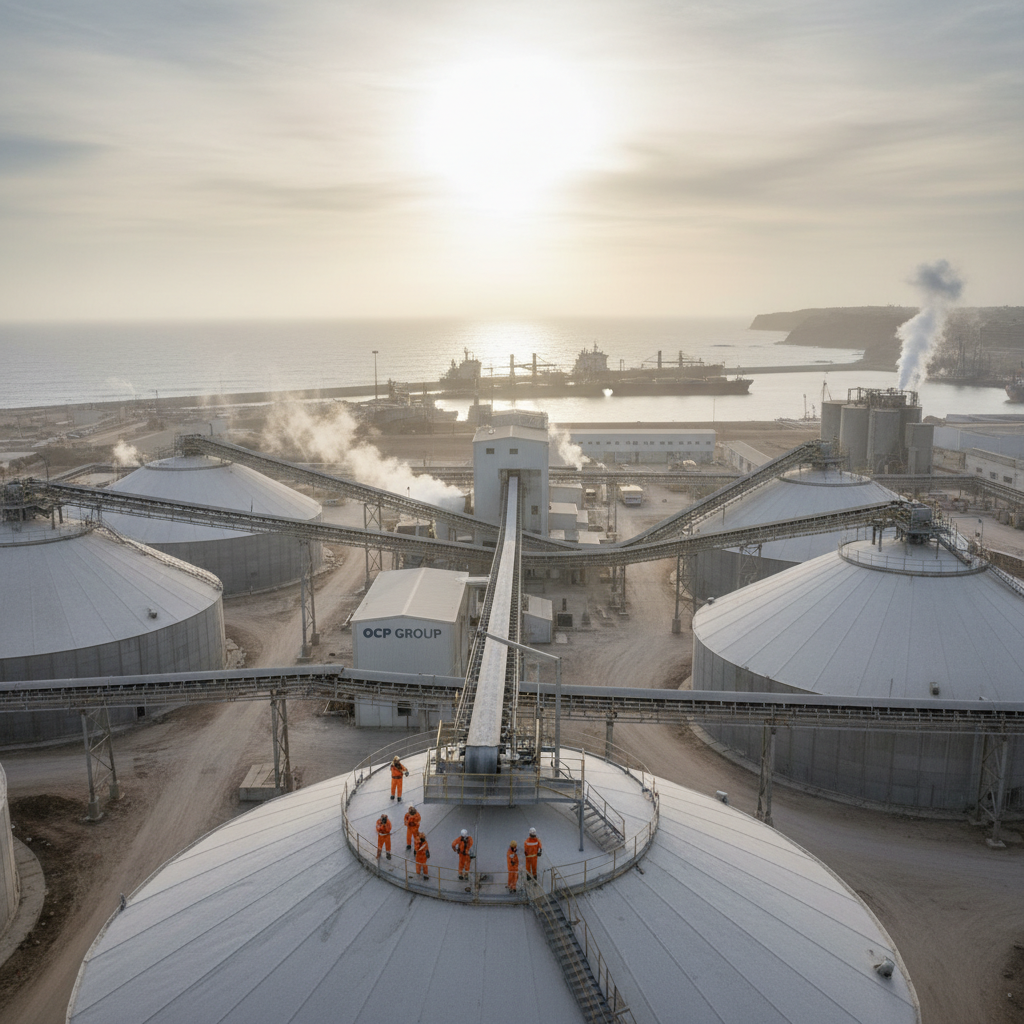
The Kingdom’s ports, from Jorf Lasfar to Tanger Med, position themselves as multimodal hubs. Slots dedicated to bulk goods, partial automation of conveyor belts, and documentary digitalization streamline operations. Freight forwarders gain predictability.
Illustrative case: an Oriental cooperative ships limestone amendments to Souss by synchronizing arrivals of phosphated fertilizers. The two-way flow reduces empty trips and costs. This type of operational engineering improves the carbon footprint and the resilience of the chains.
On the African stage, Morocco amplifies its role as a gateway. Maritime links to West Africa support agricultural intensification programs. The offer is packaged: product, agronomic advice, and seasonal monitoring, with a measurable effect on yields.
Priority actions on the supply chain side
- ⏱️ Reserve dedicated slots for solid and liquid bulks.
- 🧰 Standardize maintenance to prevent critical failures.
- 🛰️ Use real-time tracking to reduce downtime.
- 📦 Deploy advanced stocks near demand basins.
- 📑 Harmonize documentation to speed up customs clearance.
| Link ⚓ | Improvement 2025 🚀 | Effect on customer service 🤝 |
|---|---|---|
| Bulk terminals | Partial automation | Less waiting ⏳ |
| Rail-factory-port | Energy synchronization | Increased reliability ✅ |
| Customs | Generalized e-docs | Shorter cycle 📉 |
| Advanced stock | Buffer capacity + | Breaks avoided 🛡️ |
The Moroccan method gains coherence: align logistics, HR, and digital tools to deliver flawlessly, even when the market is under pressure.
Morocco–India alliance in fertilizers: volumes, contracts, and employment effects
India, which subsidizes inputs for its farmers, has multiplied long-term contracts with Morocco. The first agreements were made as early as 2023 in Rabat and have consolidated, covering 2.5 million tons via OCP Nutricrops and six Indian public and private partners. The announced target approaches 2.8 to 3 million tons delivered.
This partnership reduces Indian dependence on Asian flows and secures supplies of quality phosphate. In return, it offers Morocco industrial and financial visibility, useful for planning investment and employment. The ramp-up is accompanied by trials of formulations like TSP in several Indian states.
In the Moroccan ecosystem, HR spillovers are concrete. Needs for qualified operators, data analysts, and HSE specialists create attractive career paths. Companies cite improved engagement indicators, reflected by observable trends in forums such as best employer Morocco 2025.
The “Atlas Fertiservices” case, a fictitious Moroccan company, illustrates the dynamic. In three years, it has doubled its agronomic support team, opened an office in Ahmedabad, and implemented a cross-mobility program. Result: reduced client response times and stabilized contractual portfolio.
This intensification also raises inclusion questions. Partnerships with universities and OFPPT allow recruiting female profiles in process and quality. The transition from “job” to “profession” secures skills and consolidates the local value chain.
On the financial level, volume stability neutralizes part of the price risk. The company can hedge energy purchases, optimize maintenance stops, and spread investments. This smoothing results in clearer ESG indicators.
Focus points for decision-makers
- 📄 Volume-price flexibility clauses in long-term contracts.
- 🧑🏫 Internal academies for process, quality, and data professions.
- 🌱 Co-development of formulations adapted to local crops.
- 🛰️ Data-driven management: weather, soils, batch traceability.
- 🤝 G2G alliances to reduce political and logistical risk.
| Deal element 🤝 | Estimated value 📦 | Employment effect in Morocco 👷 |
|---|---|---|
| Annual volumes | 2.5 → 2.8-3 Mt 📈 | Technical recruitments + |
| Agronomic R&D | TSP trials multi-states 🧪 | Data, agronomy and quality + |
| Dedicated logistics | Shipping windows 🚢 | Planning and port + |
| Indian partners | 6 key players | Customer support and bilingual + |
This alliance, structural, acts like an insurance policy for the security of agricultural inputs in Asia while catalyzing qualified employment in Morocco and sector attractiveness.
Economic competition and value chains: Africa–Europe arbitrations facing natural resources
The reconfiguration of natural resources challenges Africa and Europe. Morocco, sometimes described as a gateway to the EU, now enhances its position by orchestrating regulated flows of fertilizers and derivative products. The priority is resilience, with multi-origin and multi-destination schemes.
The orchestrated scarcity of some inputs has revived the question of industrial sovereignty. States seek “anti-fragile” import contracts and shared R&D pipelines. Stable and open, Morocco becomes a natural partner to build these architectures.
This phase requires aligning climate goals and food security. Low-carbon solutions, energy efficiency, and precision fertilization help reduce emission intensities. Buyers demand traceability and proof of impact; a field where the Moroccan ecosystem is progressing rapidly.
Regionally, the extension of logistics hubs towards West Africa optimizes total cost. Operators combine shipping, agronomic advice, and seasonal financing. This integration creates qualified jobs along corridors and stabilizes yields.
The Moroccan socio-economic dimension remains central. Territorial balances, especially in the South, connect with investment and infrastructure logics, as dossiers on economy and the Sahara analyze. Impacts in terms of opportunities, training, and mobility are key for inclusion.
Leading companies promote a culture of transparency and performance. Recruitment professionalizes, career paths clarify, and cooperation with schools intensifies. This dynamic is reflected in the landscape of attractive employers, betting on skills development.
Three market scenarios and their implications
- 🟢 Stabilization: contained prices, extended contracts, increased R&D investments.
- 🟠 Medium volatility: activated logistics options, reinforced energy coverage.
- 🔴 Severe shock: prioritization of essential markets, extended strategic stocks.
| Scenario 🔭 | Morocco’s response 🇲🇦 | Effect on customers 🌾 |
|---|---|---|
| Stabilization | Capex R&D +, customer diversification | Predictable prices 🙂 |
| Volatility | Multi-port hubs, energy coverage | Service maintained ⚖️ |
| Shock | Strategic stock, prioritization | Limited breaks 🛡️ |
Key takeaway: competitiveness will come as much from flow control as from the ability to prove impact and social responsibility over time.
Moroccan agriculture: fertilizer efficiency, scarce water, and agronomic innovation
The Moroccan challenge is to increase agricultural productivity with scarcer water. Adapted fertilizers, combined with efficient irrigation, can generate yield gains while protecting soils. Solutions like TSP demonstrate their usefulness for phosphorus-demanding crops.
Trials in India with public research support inspire local approaches. The idea is to combine soil diagnosis, targeted formulation, and application schedule. This tripod makes a difference, especially in areas vulnerable to climate variability.
Field example: the “Zemamra Sols+” cooperative plans its applications based on quarterly analyses and a weather dashboard. It reduced post-application losses and improved producers’ margin. Technical advice provided via mobile strengthens adoption.
Agronomic employment is revalued. Advisors, remote sensing specialists, and laboratory technicians find new outlets. This dynamic attracts young graduates seeking meaning and evolving career paths.
On the public policy side, alignment with localized irrigation programs and organic waste valorization creates synergies. The organo-mineral mix values every unit of water and every dirham invested. Regional cooperations accelerate the spread of best practices.
Good practices for effective applications
- 🧪 Have the soil analyzed to adjust useful phosphorus.
- 📆 Split applications according to phenological stages.
- 🚿 Combine with efficient irrigation to limit leaching.
- 🌿 Test local organo-mineral combinations.
- 📱 Use weather-soil apps to manage doses.
| Crop 🌱 | Efficiency lever ⚙️ | Potential gain 📈 |
|---|---|---|
| Cereals | Targeted TSP + irrigation | Yield +10-15% 🙂 |
| Tree crops | Split applications | Fruit quality + 🍎 |
| Vegetables | EC/PH monitoring | Uniformity + 🟩 |
| Legumes | Organo-mineral mix | N fixation + 🌿 |
Underlying idea is simple: better dose, better synchronize, better measure. This is how resilient agriculture creates value and qualified jobs.
Impacts on employment and skills: from industrial site to plot
The rise in supplies is transforming professions. In industry, process operation, instrumentation, and predictive maintenance profiles are sought. In the field, agronomic advisors and data technicians become essential.
Companies structure their HR chains around continuous learning. Access to career references, visible in resources such as this employers in view panorama, facilitates mobility. Morocco thus consolidates its brand as a country training talent.
Territories benefit from being connected to industrial and logistics projects. Areas close to ports and railway corridors see emerging skills hubs. Local initiatives, notably in the South, demonstrate economic ripple capacity, like debates on the Sahara economy.
The sector also attracts STEM profiles oriented towards data. IoT sensors, digital twins, and advanced planning systems enter factories and farms. This technical hybridization favors transversal careers, from laboratory to loading dock.
From farmers’ point of view, access to reliable inputs and technical support is decisive. Cooperatives co-constructing fertilization plans gain in yield and stability, reducing exposure to climate shocks. Rural youth find qualified job opportunities there.
High employability skills
- 🧠 Data and modeling for flow and yield management.
- 🔧 Maintenance 4.0 and operational reliability.
- 🧑🌾 Agronomic advice and fertilization management.
- 🛡️ HSE, compliance and ESG reporting.
- 🌐 International negotiation and contract management.
| Job segment 👔 | Key skills 🧩 | Usage example 🔬 |
|---|---|---|
| Processes | Instrumentation, advanced control | Optimize energy consumption ⚡ |
| Logistics | Planning, WMS/TMS | Reduce stopover time ⛴️ |
| Agronomy | Soil diagnostics, TSP/DAP | Adapt doses to crops 🌾 |
| ESG | Traceability, reporting | Access demanding markets 🌍 |
At the national scale, this skills rise feeds competitiveness and inclusion. It combines industry, services, and agriculture in the same value chain.
In this context, strategic dossiers on the economic balance of the South enlighten infrastructure and education choices. The whole builds a trajectory of opportunities in line with national ambitions.
The HR dynamic, aligned with the strategy of smart exports and imports, becomes a defendable advantage against global economic competition.
Companies visible in comparisons such as the ranking of employers in Morocco illustrate this maturity through their mobility, diversity, and continuous learning programs.
{“@context”:”https://schema.org”,”@type”:”FAQPage”,”mainEntity”:[{“@type”:”Question”,”name”:”Pourquoi le Maroc intensifie-t-il ses approvisionnements en engrais ?”,”acceptedAnswer”:{“@type”:”Answer”,”text”:”La contraction des exportations asiatiques, notamment du DAP, a cru00e9u00e9 un du00e9ficit pour de grands acheteurs. Le Maroc, dotu00e9 de 70 % des ru00e9serves mondiales de phosphate, saisit cette opportunitu00e9 pour su00e9curiser des volumes, stabiliser les prix et soutenir la su00e9curitu00e9 alimentaire ru00e9gionale.”}},{“@type”:”Question”,”name”:”Quel est lu2019impact sur lu2019emploi au Maroc ?”,”acceptedAnswer”:{“@type”:”Answer”,”text”:”La montu00e9e en charge des volumes et des services agronomiques cru00e9e des postes qualifiu00e9s en procu00e9du00e9s, logistique, data et conseil. Les territoires proches des ports et des zones industrielles bu00e9nu00e9ficient du2019un effet du2019entrau00eenement.”}},{“@type”:”Question”,”name”:”Que changent les accords Marocu2013Inde ?”,”acceptedAnswer”:{“@type”:”Answer”,”text”:”Ils garantissent des livraisons de 2,5 u00e0 pru00e8s de 3 millions de tonnes, ru00e9duisent la du00e9pendance indienne et donnent au Maroc une visibilitu00e9 pour investir dans lu2019outil industriel, lu2019innovation et la formation.”}},{“@type”:”Question”,”name”:”Comment les agriculteurs marocains profitent-ils de ces dynamiques ?”,”acceptedAnswer”:{“@type”:”Answer”,”text”:”Gru00e2ce u00e0 des intrants plus ru00e9guliers, des conseils de fertilisation et des outils numu00e9riques, les producteurs optimisent les rendements et la marge, tout en u00e9conomisant lu2019eau et en pru00e9servant les sols.”}},{“@type”:”Question”,”name”:”Quelles prioritu00e9s pour renforcer la ru00e9silience ?”,”acceptedAnswer”:{“@type”:”Answer”,”text”:”Diversifier les routes logistiques, augmenter les stocks tampons, investir dans lu2019efficacitu00e9 u00e9nergu00e9tique et accu00e9lu00e9rer lu2019innovation agronomique pour stabiliser lu2019offre malgru00e9 les alu00e9as.”}}]}Why is Morocco increasing its fertilizer supplies?
The contraction of Asian exports, notably DAP, has created a deficit for large buyers. Morocco, endowed with 70% of the world’s phosphate reserves, seizes this opportunity to secure volumes, stabilize prices, and support regional food security.
What is the impact on employment in Morocco?
The increase in volumes and agronomic services creates qualified positions in processes, logistics, data, and advisory. Territories close to ports and industrial zones benefit from a ripple effect.
What do the Morocco–India agreements change?
They guarantee deliveries from 2.5 to nearly 3 million tons, reduce Indian dependence, and give Morocco visibility to invest in industrial tools, innovation, and training.
How do Moroccan farmers benefit from these dynamics?
Thanks to more regular inputs, fertilization advice, and digital tools, producers optimize yields and margins while saving water and preserving soils.
What are the priorities to strengthen resilience?
Diversify logistics routes, increase buffer stocks, invest in energy efficiency, and accelerate agronomic innovation to stabilize supply despite uncertainties.

Comments are closed