
The international mobility of Moroccan talents and entrepreneurs is facing a new major challenge at the beginning of 2026. While the Kingdom strengthens its position as a continental economic hub, a complex administrative reality is slowing down the ambitions of many professionals: the significant lengthening of waiting times to obtain a U.S. visa. Morocco is not an isolated case; it now joins a group of seven other major African nations confronted with this saturation of consular services.
Pressure mounts on the Casablanca consulate
For Moroccan applicants, patience has become the key virtue. The U.S. Embassy in Casablanca is facing an unprecedented increase in the volume of files. This rise in demand concerns all segments of the population: from students aspiring to attend American universities to executives on business missions, as well as families wishing to visit their relatives.
The delays are not solely the result of increased enthusiasm. They also stem from tightened security procedures. Verification protocols, stricter and more thorough, slow down the processing of each file. This situation is particularly penalizing for first-time applicants for tourist and business visas (B1/B2), who often face fully booked appointment schedules for several months.
In this tense context, it becomes crucial for professionals to diversify their horizons. If the American door seems heavy to push, other opportunities are emerging. For example, interest in Europe remains strong, as evidenced by flows to other destinations, and it is relevant to monitor developments elsewhere, such as procedures for the Portugal visa for Moroccans, which offers an interesting alternative for access to Western markets.
A strong trend at the continental level 🌍
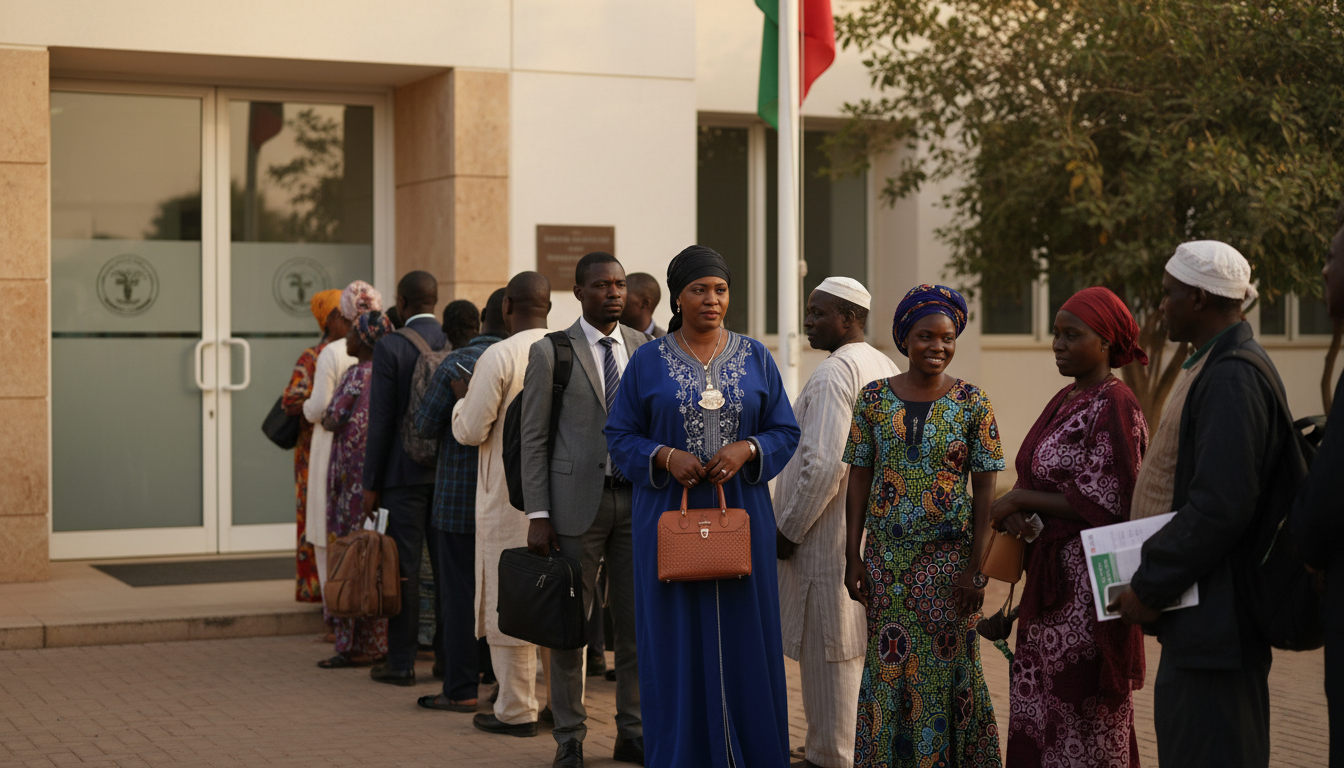
Morocco is part of a broader regional dynamic. Seven other African countries — Uganda, Egypt, Nigeria, South Africa, Tanzania, Ethiopia, and Zambia — share this observation of congestion. This situation reflects a growth crisis of African mobility towards the United States. Demand is exploding, but processing capacities are struggling to keep up with the pace imposed by new security requirements.
In Egypt and Uganda, the embassies in Cairo and Kampala are overwhelmed with files. Virtual queues are lengthening, affecting both nationals and third-country applicants transiting through these hubs. This widespread saturation complicates the strategic planning of African companies aiming to internationalize their activities.
To better understand this dynamic, here is an overview of the difficulties faced by these key nations in 2026:
| Country concerned | Major issue | Specific impact 2026 |
|---|---|---|
| Morocco 🇲🇦 | Massive increase in applications (Studies, Business, Tourism) | Fully booked appointments in Casablanca, delays of several months for B1/B2 visas. |
| Nigeria 🇳🇬 | Critical volume and thorough checks | Partial restrictions on B1/B2 visas effective from January 2026. |
| South Africa 🇿🇦 | Consulate congestion (Pretoria, Cape Town, Joburg) | Controversial prioritization of certain files, slowing overall flow. |
| Tanzania & Zambia 🇹🇿 🇿🇲 | Limited capacities and new restrictions | Inclusion in the list of partial American restrictions early 2026. |
This data confirms that visa delays between Morocco and Africa and the United States are not an isolated incident, but a structural trend that requires rapid adaptation by economic operators.

The direct impact on Moroccan employment and business
For recruiters and human resources directors in Morocco, these delays introduce detrimental uncertainty. Sending an employee for training in Silicon Valley or attending a conference in New York now requires anticipation of six to eight months, or even more. This rigidity can be costly in terms of missed business opportunities.
The situation is all the more critical as the Moroccan job market is booming. Young graduates, often tempted by an experience across the Atlantic, must rethink their short-term career plans. Fortunately, local dynamism provides alternatives. Opportunities listed on platforms such as Wadif 2025 for employment in Morocco show that the domestic market remains a powerful talent absorption engine.
Which profiles are most affected?
Restrictions and delays do not affect all applicants with the same intensity. Consular data analysis identifies the categories most vulnerable to these administrative bottlenecks:
- 📋 First-time B1/B2 applicants: Those who have never traveled to the USA face the longest checks.
- 🎓 Students: The risk of missing the American university intake is real without anticipation of at least one year.
- 💼 Last-minute business travelers: The inability to obtain an emergency appointment hinders commercial responsiveness.
- 👨👩👧👦 Family visits: Gatherings for holidays or family events are often compromised by date uncertainties.
Faced with this partial blockage towards the West, the attention of investors and travelers also turns East. The reopening and facilitation of exchanges with Asia create a windfall. The new procedures for the China visa for Moroccans in 2025 demonstrate a desire to streamline commercial exchanges, offering a viable alternative for sourcing and technological partnerships.

Anticipate to avoid suffering
The key to navigating this complex environment lies in extreme anticipation. It is no longer possible to consider travel to the United States as a quick administrative formality. For Moroccan companies, this means integrating the “visa” risk into any international development project involving the USA.
Moreover, diversifying partners remains a winning strategy. If America slows down, Europe continues to adjust its arrangements. Although processes are rigorous, keeping informed with the German embassy in Morocco or other European chancelleries allows Moroccan executives to maintain active international mobility.
Finally, it is essential to remain vigilant regarding regulatory developments. The announcements in January 2026 concerning partial restrictions for certain African countries (like Nigeria or Tanzania) could, by ripple effect or reorganization of regional consular services, influence waiting times in Morocco. Informative monitoring is therefore, more than ever, a career and business management tool.
Why are U.S. visa waiting times so long in Morocco in 2026?
Waiting times result from a combination of factors: a post-pandemic surge in demand, catching up on backlogged files, and especially the introduction of much stricter security and background check protocols by U.S. authorities.
Is Morocco affected by the new visa restrictions of January 2026?
Unlike Nigeria, Zambia, or Tanzania, which face partial restrictions on visa issuance, Morocco mainly faces extended processing times due to saturation, without formal bans on visa categories.
What are the alternatives for urgent business trips?
It is very difficult to accelerate a U.S. procedure currently. Companies are encouraged to plan 6 to 9 months in advance or explore commercial alternatives towards Europe or Asia (China, etc.) where procedures can be smoother for Moroccan professionals.
Are Moroccan students given priority for appointments?
Consulates generally try to process student visas (F1) before university start dates, but given the current congestion in Casablanca, it is imperative to start the procedure as soon as the admission (I-20) is received, without waiting for the summer.

No responses yet