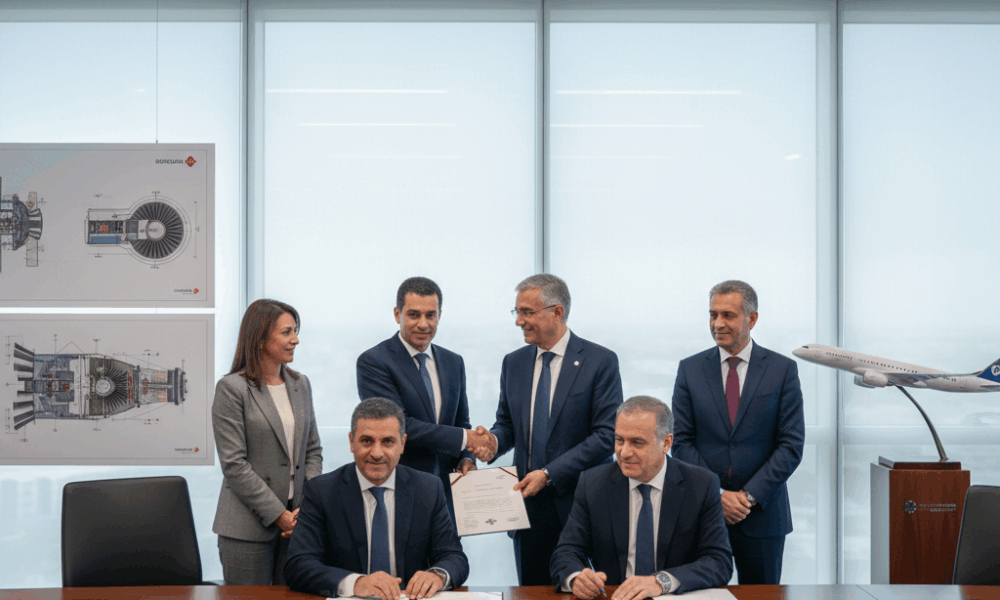
Morocco–Safran Agreement: Nouaceur Becomes the Largest Aircraft Engine Assembly Center in Africa
The signing of an industrial agreement between the Kingdom and Safran propels the Midparc Nouaceur area to the status of the largest aircraft engine assembly center on the continent. The complex, anchored by the LEAP‑1A engine program aimed notably at the Airbus A320neo families and, by extension of the range, at mixed fleets operated with Boeing, marks a strategic turning point. Announced in Rabat during the National Industry Day, the project symbolizes the culmination of 26 years of consistent industrial policy and skills development driven by a clear vision of technological sovereignty.
The setup includes a final engine assembly line, a test center, and a maintenance workshop. Ultimately, the targeted capacity is 350 engines assembled per year, with an investment envelope of approximately €350 million, while the MRO branch will reach 150 engine overhauls per year. The initiative positions Morocco within the small circle of countries capable of assembling the propulsion core of a commercial aircraft, alongside the Villaroche site in France, Safran’s global reference for LEAP. The Moroccan ecosystem now goes beyond the mere manufacture of nacelles to approach the production of critical components, including certain hot sections known for their metallurgical demands.
This progress is not limited to the industrial aspect. The expected benefits affect exports, skilled employment, and the densification of the subcontracting network. In 2024, Moroccan aeronautical exports reached approximately 21.86 billion MAD, up by 17.3%. The new complex should contribute to doubling the sectoral level at full capacity, while generating nearly 900 direct jobs by 2030, not counting indirect positions in logistics, engineering, and quality.
The momentum brings together global players already established in Morocco, such as Thales (avionics), Hexcel (composites), Stelia Aerospace (aerostructures), and Eaton (hydraulic systems). It also creates commercial bridges with Dassault Aviation, Bombardier, and strengthens the supplier base for the Airbus and Boeing chains. On the operational side, carriers such as Royal Air Maroc will benefit from a nearby LEAP MRO capability, a rare asset in Africa and south of the Mediterranean.
Industrial Capacities and Strategic Positioning
Located at the crossroads of mature logistics corridors, the Nouaceur hub capitalizes on reduced transit times, competitive energy, and institutional stability recognized by investors. The partnership philosophy, summarized by the idea of producing “with” Morocco, aligns the interests of equipment manufacturers and the state around local engineering, R&D, and a robust talent policy. The model aims for local integration, “zero-defect” quality, and accelerated industrialization of complex processes.
- 🚀 Progressive commissioning of the LEAP‑1A line and test bench.
- 🧩 Integration of local suppliers in composites, precision machining, and surface treatments.
- 📈 Increased sectoral export target, driven by engine added value.
- 🛫 Customer synergies with Airbus, Boeing, and African and European operators.
- 🤝 Deepened cooperation between Safran, the Moroccan ecosystem, and training centers.
| Key Element ✈️ | Detail 🔎 |
|---|---|
| Location | Midparc Nouaceur, near Casablanca airport 🌍 |
| Investment | About €350 million 💶 |
| Assembly capacity | 350 engines/year ⚙️ |
| MRO capacity | 150 engines/year 🧰 |
| Direct jobs | Nearly 900 by 2030 horizon 👩🏭👨🏭 |
By establishing itself as the LEAP reference platform outside France, Morocco gains technological depth and decisive international visibility for the next step: high knowledge intensity engineering.
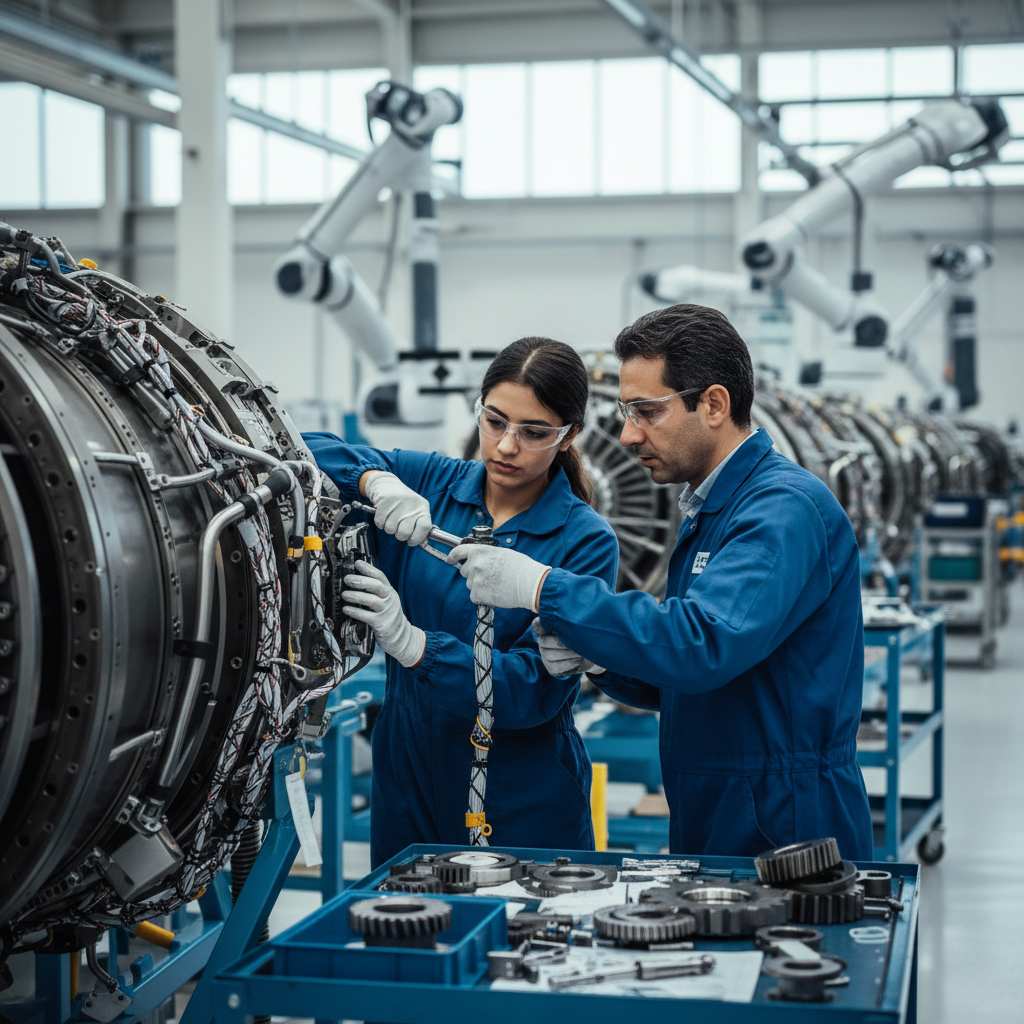
Impact on Skilled Employment in Morocco: Trades, Skills, and Training for LEAP Motorization
The industrial upgrade translates into a reconfiguration of trades. Engine assembly and MRO activities require profiles capable of mastering tight tolerances, high-temperature materials, and complex testing methods. OFPPT curricula, engineering schools, and universities are called upon to provide immediately operational technicians and engineers, supported by training in metrology, aeronautical safety, and data applied to predictive maintenance.
For young people in transition, access to first jobs goes through flexible paths combining work-study, certifications, and internships. Support mechanisms facilitate entry into demanding environments, with an emphasis on problem-solving and teamwork soft skills. Practical resources already exist to position oneself, such as this ANAPEC skills guide, useful for mapping the sector prerequisites: skills and integration with ANAPEC. Students and recent graduates can also explore paid internship opportunities designed to accelerate employability in technical positions.
Trades in Demand and Career Pathways
Assembly and test plants require a chain of skills ranging from line operator to production manager, including quality and supply chain. MRO, on its side, attracts profiles who like diagnosing, disassembling, inspecting, and reassembling sub-assemblies in certified environments. Having a hub in Nouaceur opens the way to complete career paths without leaving Morocco: production, methods, industrialization, then program supervision.
- 🧪 Process technicians (heat treatments, non-destructive testing) highly sought after.
- 🛠️ LEAP engine assemblers, with mastery of aeronautical documentation and critical torques.
- 📊 Quality, data, and reliability engineers to optimize “first pass yield” rates.
- 🤖 Automation and digital twin specialists for assembly and testing.
- 🧭 Supply chain planners, purchasing, and aeronautical logistics.
| Trade Family 🧩 | Expected Skills 🎓 | Career Progression 📈 |
|---|---|---|
| Engine Assembly | EASA/FAA documentation, tooling, critical cleanliness ✨ | Adjuster → Team Leader → Supervisor 🧑🏭 |
| Testing and Test Benches | Instrumentation, vibration, signature analysis 📡 | Test Engineer → Performance Expert 🚀 |
| MRO | Diagnostics, CND, digital traceability 🧾 | Technician → Shop Visit Planner 🛫 |
| Quality/Reliability | 5S, Six Sigma, FAI, FMEA ✅ | Engineer → Black Belt → Site Quality 🏆 |
| Supply Chain | MRP, S&OP, supplier management 🔗 | Purchaser → Buyer → Supply Manager 🧭 |
This employment dynamic is coupled with a demanding corporate culture. Organizations involved in aeronautics often stand out for their HR policies and transparency. To compare practices and get information on environments favorable to professional fulfillment, the ranking of the best employer in Morocco is a useful benchmark for candidates and recruiters.

In short, the Nouaceur hub acts as an accelerator of transferable skills towards automotive, energy, and mechatronics, consolidating an industrial base up to global standards.
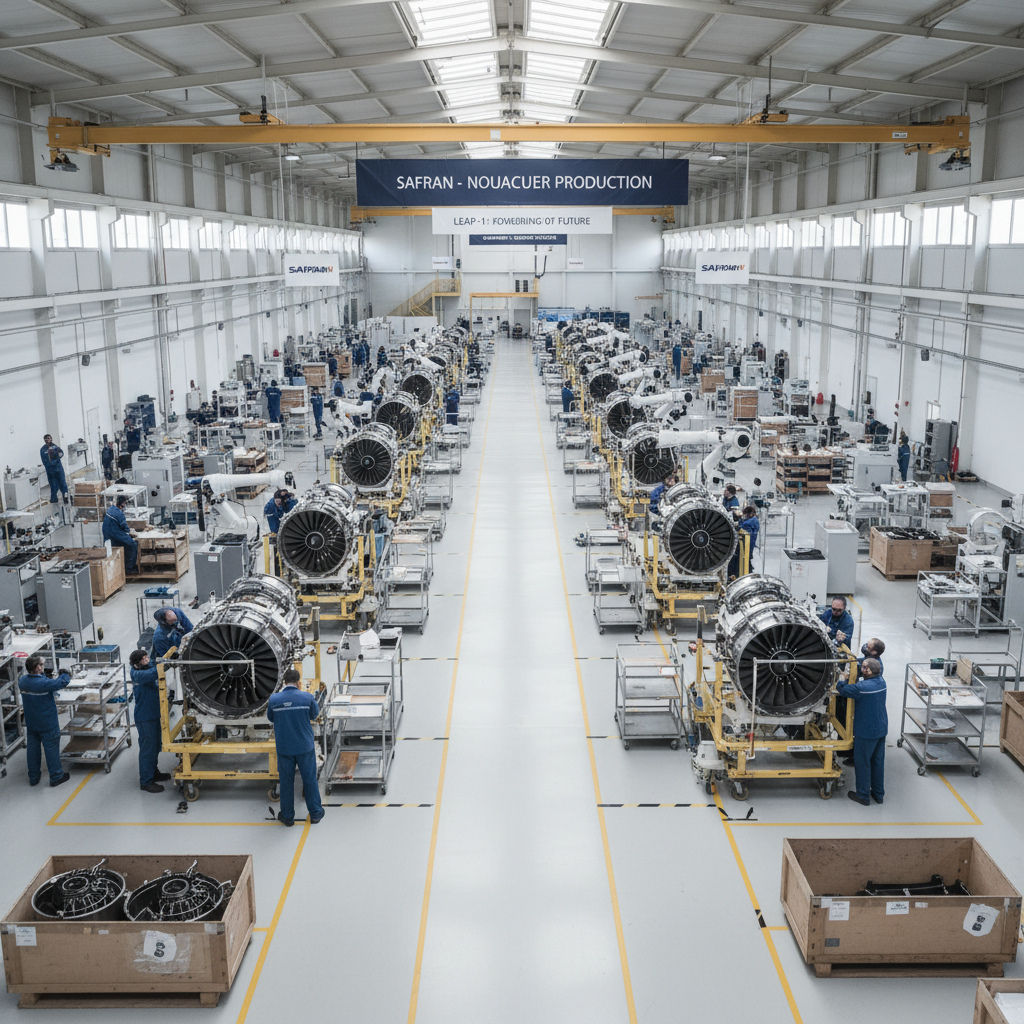
Supply Chain and Ecosystem: From Casablanca to Tangier, an Accelerating Industrial Network
Engine success relies on a reliable, diversified, and fast supply chain. Around Nouaceur, a network of global equipment manufacturers and Moroccan SMEs is growing in strength. Players such as Hexcel (composites), Stelia Aerospace (structures), Thales (electronic systems), Eaton (hydraulics), and Bombardier (aerostructures) ensure a solid base to support LEAP assembly. Morocco’s logistical positioning, reinforced by Tangier Med and a bundle of road and rail infrastructures, lowers costs and lead times for the delivery of sensitive parts.
The Casablanca–Tangier corridor also attracts international logistics operators. Announcements from global groups strengthening their hubs echo the national industrial ambition. For example, developments around supply chain and warehousing solutions highlighted in the news about logistics employment driven by Japanese investors illustrate the potential for creating indirect jobs. The northern territories, already energized by Tangier Med, are positioning themselves to welcome new suppliers, as shown by the economic outlook emphasized for Tangier-Assilah.
Supplier Network and Operational Quality
In an industry where every cycle minute counts, the resilience of the chain depends on certification, traceability, and redundancy of sources. Moroccan SMEs align with these standards through maturity-raising programs (AS/EN 9100, NADCAP), facilitating their integration into high-value part packages. This cluster logic reduces supply risks and supports LEAP line productivity.
- 🏗️ Increasing certification levels for special treatments and precision machining.
- 🚚 Access to high-throughput logistics corridors via Tangier Med and the A1 axis.
- 🔁 Business continuity plans and multi-sourcing for critical parts.
- 🧠 Engineering sharing and co-development between Safran and local suppliers.
- 🌱 Competitive and green energy to reduce the carbon footprint of operations.
| Ecosystem Node 🗺️ | Role in Engine Flow 🔩 | Key Benefits ✅ |
|---|---|---|
| Midparc Nouaceur | Assembly, testing, LEAP MRO ⚙️ | Integration, quality, customer proximity 🏅 |
| Tangier Med | Inbound/outbound, parts and modules 🚢 | Reduced lead time, lower logistics costs ↓ |
| Global suppliers (Hexcel, Stelia, Thales, Eaton) | Composites, structures, avionics, hydraulics 🧩 | Reliability, innovation, volume 📦 |
| Moroccan SMEs | Machining, wiring, special treatments 🔧 | Agility, competitive cost, proximity 🤝 |
| Customer platforms (Airbus, Boeing, Dassault Aviation, Bombardier) | Aircraft integration and support 🛫 | Market traction, quality requirement 🧭 |
This network, designed to absorb peak loads, places Morocco at the heart of Euro-Mediterranean aeronautical flows. It also facilitates the anchoring of shared R&D activities, foreshadowing the integration of innovations in future engine generations.
Maintenance, Testing, and Durability: LEAP MRO in Casablanca as a Growth Relay
The MRO (maintenance, repair, overhaul) component complements assembly to secure the engine service life. With a targeted capacity of 150 engines/year, the Casablanca workshop will meet the growing demand for LEAP “shop visits” in Africa, the Middle East, and Europe. Processes will include inspection by correlation of vibration signatures, advanced non-destructive testing, and reassembly according to tight specifications, to ensure performance and optimized turnaround times.
The workshop is part of a sustainability approach: reuse of components after repair, material recycling streams, electricity partly sourced from renewables, and digitization to minimize scrap. Airlines operating A320neo and 737 MAX fleets will benefit from a nearby MRO hub, with particular attention to Royal Air Maroc, which will be able to calibrate its immobilizations and maintenance costs with greater predictability.
Technologies, Services, and Reliability
Digital innovations support safety and availability: digital twin of the engine, flight data analysis, condition-based maintenance. This orchestration allows anticipating failures, planning interventions as precisely as possible, and maximizing hours on wing. Proximity to a test center also promotes short-loop feedback between the workshop and the assembly line.
- 🛠️ MRO services: inspection, repair, reassembly, test bench certifications.
- 📡 Data & AI: anomaly detection, optimization of visit cycles.
- ♻️ Circular economy: increased repairability, reduction of technical waste.
- 🧪 Advanced metrology: CND, high-precision dimensional measurements.
- ⏱️ Continuous improvement: OEE, “first pass yield,” and operational safety.
| MRO Dimension 🧰 | Key Indicators 📊 | Value for Operators ✈️ |
|---|---|---|
| Capacity | 150 engines/year at target rate 🔄 | Reduced queues, increased availability ✅ |
| Reliability | Final tests, vibration control, traceability 🧾 | Stable performance, fewer workshop returns 🛡️ |
| Durability | Parts reuse, green energy ♻️ | Controlled costs, responsible image 🌿 |
| Digital | Digital twin, condition-based maintenance 🧠 | Optimized planning, reduced downtime ↓ |

With this asset, Morocco strengthens a critical service for airlines and consolidates its credibility as a complete hub: from assembly to maintenance, and from testing to in-service reliability.
Public Policies and Economic Impact: Exports, Innovation, and Territorial Inclusion
The project fits into a public strategy based on three pillars: talents, competitive energy, and partnerships. Since 2021, industrial exports have more than doubled, supported by value localization, quality standardization, and anchoring of long-term investments. The agreement around the LEAP engine accelerates this trajectory by creating a complex finished product “made in Morocco” capable of impacting the trade balance.
The benefits go beyond sectoral borders. The ripple effect on logistics, subcontracting, and B2B services is notable. Dynamics observed with the establishment of new supply chain actors confirm the alignment of industrial policy and employment, as illustrated by announcements regarding the expansion of logistics operators. At the territorial level, the country’s north continues its economic transformation, in line with the ambitions supported for Tangier-Assilah, while the Casablanca-Settat region consolidates its status as an industrial locomotive.
Governance, National Image, and Talent Mobilization
Institutional stability, quality infrastructure, and international visibility play a key role in the Kingdom’s attractiveness. National cohesion and momentum are also expressed through the valorization of symbolic projects and unifying moments, which build investor and talent confidence. In this regard, the insights on the diplomatic scene and the Kingdom’s influence, as mentioned during these times of national mobilization, reinforce the narrative of a country resolutely oriented toward the future.
- 🏛️ Public-private partnerships: industrial anchoring and long-term visibility.
- 🔋 Competitive energy mix: integration of renewables in sites.
- 👩🎓 Inclusion of youth and women in STEM fields.
- 🧭 Decentralization: industrial network from Tangier to Nouaceur.
- 🌐 Economic diplomacy: attractiveness of industrial FDI.
| Policy Lever 🧱 | Impact Mechanism ⚙️ | Expected Result 📈 |
|---|---|---|
| Targeted Training | OFPPT, engineering schools, certifications ✍️ | Ready-to-work talents, increased productivity ↑ |
| Competitive Energy | Renewables, long-term contracts 🔌 | Stable costs, reduced footprint 🌿 |
| Clusters | Midparc, Tangier Med, free zones 🧭 | Network effect, reduced lead time ↓ |
| Employer Brand | HR transparency, internal mobility 💼 | Talent attraction/retention ⭐ |
To guide job seekers, rankings of management quality and working conditions remain concrete benchmarks. Exploring references such as the best employer ranking helps target the most virtuous organizations, while specialized platforms allow aligning career projects with aeronautical needs. This articulation between public policies and private initiatives is the key to inclusive and sustainable growth.
Global Industrial Relations and Industrial Upgrade: From Assembly to Complete Innovation
Beyond production, the Safran–Morocco agreement acts as an innovation multiplier. The synchronized presence of players such as Thales, Hexcel, Stelia Aerospace, and Eaton creates an environment conducive to co-development of advanced materials, connected avionics, and more efficient systems. Feedback from MRO feeds assembly engineering and, conversely, design choices are enriched by field realities.
Collaborations with aircraft manufacturers – Airbus, Boeing, Dassault Aviation, Bombardier – strengthen mastery of system integration. As industrialization level progresses, the Moroccan ecosystem positions itself to host R&D units, joint laboratories, and pilot programs on energy efficiency and predictive maintenance. Local companies, supported by public authorities, gain maturity to handle critical components, including precision metallurgy.
Acceleration through Talent and Data
The availability of a talent pool, combined with industrial data platforms, paves the way for rapid gains in quality and cost. Performance analytics tools, line digital twins, and logistics flow simulation feed daily decision-making. Morocco’s capacity to orchestrate this continuous improvement loop will provide a durable and hard-to-replicate competitive advantage.
- 🧠 Co-engineering with OEMs and tier suppliers to accelerate innovation.
- 🛰️ Connected avionics and data to improve fleet availability.
- 🧪 New generation materials and treatments for hot sections.
- 📦 Data-driven and load forecasting supply chain.
- 🌍 Regional anchoring: service for African and Euro-Mediterranean airlines.
| Innovation Dimension 💡 | Concrete Examples 🔬 | Expected Effects ⚡ |
|---|---|---|
| Process | Flexible LEAP line, smart tooling 🛠️ | Increased productivity ↑, decreased variability ↓ |
| Product | Repairable parts, optimized materials 🧱 | Lower life cycle cost ↓, higher reliability ↑ |
| Services | Data-driven MRO, pay-per-flight contracts ⏳ | Predictability, client satisfaction 😊 |
| Ecosystem | R&D partnerships, joint labs 🧪 | Knowledge dissemination, upgrade path 📚 |
Morocco no longer just assembles; it structures a continuum from design to maintenance, laying the foundations of an innovative industrial economy. For talents, it is the assurance of long and evolving careers in a highly technology-intensive sector.
{“@context”:”https://schema.org”,”@type”:”FAQPage”,”mainEntity”:[{“@type”:”Question”,”name”:”What capacities are targeted by the Nouaceur complex?”,”acceptedAnswer”:{“@type”:”Answer”,”text”:”The site groups a final assembly line for LEAP‑1A engines (about 350 engines/year), a test center, and an MRO workshop sized for 150 engines/year, with nearly 900 direct jobs expected by 2030.”}},{“@type”:”Question”,”name”:”What benefits for airlines operating in Morocco and Africa?”,”acceptedAnswer”:{“@type”:”Answer”,”text”:”The presence of a LEAP MRO in Casablanca reduces shop visit delays, improves fleet availability, and lowers logistics costs, with a proximity service for Royal Air Maroc and other regional operators.”}},{“@type”:”Question”,”name”:”How can young graduates access these trades?”,”acceptedAnswer”:{“@type”:”Answer”,”text”:”By combining paid internships, technical certifications, and ANAPEC support. Resources such as the ANAPEC skills guide and internship offers help target the competencies sought in assembly, testing, and maintenance.”}},{“@type”:”Question”,”name”:”What is the expected macroeconomic impact?”,”acceptedAnswer”:{“@type”:”Answer”,”text”:”Significant increase in aeronautical exports, creation of skilled jobs, local added value growth, and strengthening of Morocco’s attractiveness for long-term industrial investments.”}}]}What capacities are targeted by the Nouaceur complex?
The site groups a final assembly line for LEAP‑1A engines (about 350 engines/year), a test center, and an MRO workshop sized for 150 engines/year, with nearly 900 direct jobs expected by 2030.
What benefits for airlines operating in Morocco and Africa?
The presence of a LEAP MRO in Casablanca reduces shop visit delays, improves fleet availability, and lowers logistics costs, with a proximity service for Royal Air Maroc and other regional operators.
How can young graduates access these trades?
By combining paid internships, technical certifications, and ANAPEC support. Resources such as the ANAPEC skills guide and internship offers help target the competencies sought in assembly, testing, and maintenance.
What is the expected macroeconomic impact?
Significant increase in aeronautical exports, creation of skilled jobs, local added value growth, and strengthening of Morocco’s attractiveness for long-term industrial investments.

Comments are closed