The Evolution of Mobility toward Asia: New Opportunities for Moroccans
The landscape of international travel for Moroccan citizens is undergoing a positive transformation, especially towards Southeast Asia. Long seen as a dream destination requiring complex administrative procedures, Thailand has radically simplified its entry procedures. In 2025, the Kingdom of Siam’s immigration policy moves towards greater openness, facilitating not only tourism but also professional exchanges and digital nomadism.
This dynamic fits into a broader trend where Moroccan passport holders see their horizons expand, progressively joining the list of visa-free countries for Moroccans or those with eased formalities. For HR professionals and business travelers, understanding these mechanisms is crucial for planning stays, conferences, or periods of remote work under the tropics.
The 60-Day Visa Exemption: A Major Turning Point
The major news redefining the Thailand trip for Moroccan nationals is the extension of the visa exemption policy. Now, for a standard tourist stay, it is no longer systematically necessary to undertake a complex application procedure before departure. Thai authorities grant an exemption allowing stays on the territory for up to 60 days. ✈️
This measure aims to boost the tourism economy and position Bangkok as an essential regional hub, rivaling other popular Asian destinations. By comparison, procedures for other destinations remain stricter, as can be seen with the China visa for Morocco in 2025, which retains its own regulatory specificities.
Eligibility Conditions and Documents to Present
Although it is called an exemption, entry is not unconditional. The immigration officer at the checkpoint remains the final decision-maker. To ensure smooth passage, several elements must be presented:
- 🛂 Valid Passport: It must have a residual validity of at least 6 months at the date of entry.
- 🎫 Onward or Return Ticket: Proof that you intend to leave the territory within the allotted 60 days is often required by airlines departing from Morocco.
- 💰 Proof of Funds: Although rarely systematically checked for tourists of a “typical” appearance, the law stipulates that the traveler must be able to justify sufficient financial means for the duration of the stay (about 20,000 THB per person).
- 🏨 Proof of Accommodation: A hotel reservation for the first nights is highly recommended.
End of Paper Forms: Welcome TDAC
The era of handwritten paperwork on the plane is coming to an end. The famous blue TM6 form has been replaced by the TDAC (Thailand Digital Arrival Card). This digitalization aligns with international border management standards.
The TDAC is mandatory for all foreign travelers. It is not a visa, but an administrative formality for security and public health. This form must be filled out online before your arrival, ideally within 72 hours prior to the flight. The system generates a confirmation that you must keep, as it may be requested during boarding or passport control upon arrival at Suvarnabhumi or Phuket. 📱
The E-Visa: The Solution for Long Stays and Professionals
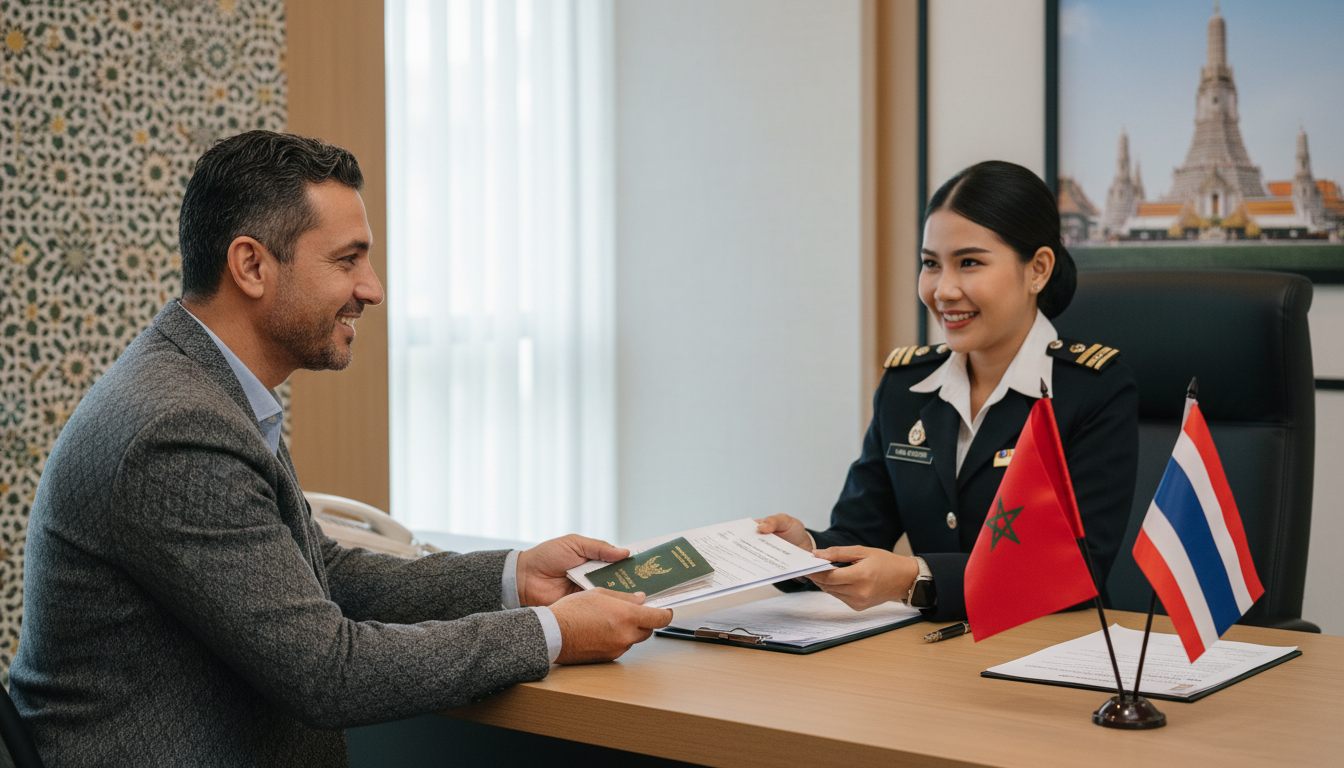
If your project goes beyond short-term tourism or if you want to secure your entry for specific reasons (work, retirement, studies), the Thailand visa 2025 procedure now exclusively goes through the electronic channel. The embassy in Rabat no longer accepts physical files for standard applications.
The official platform `thaievisa.go.th` centralizes all requests. This is a significant advancement that avoids costly travel and queues, contrasting with difficulties sometimes encountered with other European visa centers, such as procedures at the BLS Rabat center.
The DTV Visa: A Boon for Digital Nomads
For Moroccan consultants, freelancers, and remote workers, the new Destination Thailand Visa (DTV) is a revolution. Valid for 5 years, it allows stays of 180 days per entry, extendable once. It is the perfect answer to the rise of international teleworking, offering a legal framework to work from Thailand for foreign clients.
This visa is especially aimed at those interested in global opportunities and innovation, a related subject to the digital and innovation visa developing in several tech hubs.
| Entry Type | Stay Duration | Cost (Approx.) | Target Audience |
|---|---|---|---|
| Visa Exemption | 60 days (extendable 30d) | Free (on arrival) | Tourism, short family visit 🏖️ |
| E-Tourist Visa (TR) | 60 days (+30d) | ~40 USD | Planned tourism, entry security 🗺️ |
| Destination Thailand Visa (DTV) | 180 days (multiple entries / 5 years) | ~300 USD | Digital nomads, Muay Thai, Cooking 💻 |
| Non-Immigrant B Visa | 90 days (then work permit) | Variable | Employed work in Thailand 👔 |
The Procedures to Obtain Your Visa Online
For those opting for the E-Visa, rigor is required when uploading documents. A format error or a non-compliant photo can result in immediate rejection without refunding fees. It is essential to scan passport pages in high quality and provide clear bank statements if requested.
The processing time has been optimized, but it remains wise to start early. Contrary to the administrative burden sometimes felt with the Schengen visa procedures, the Thai system aims to be smoother, although very strict on the form of digital documents.
On-site Stay Extension
An appreciable flexibility of the Thai system lies in the possibility to extend your stay without leaving the country. Whether you entered with an exemption or a tourist visa, you can apply for a 30-day extension at a local immigration office for 1,900 THB. This brings the total possible duration to nearly 3 months, ideal for deep cultural immersion.
However, beware of abuses: “visa runs” (repeated exits and entries) are increasingly monitored. For a lasting stay, it is preferable to opt for appropriate long-stay visas.
Preparing Your Departure from Morocco
Beyond administrative formalities, the success of the trip relies on good anticipation. Flights from Casablanca to Bangkok generally require a stopover (often via the Middle East or Europe). Ensure that your transits do not require specific transit visas, especially if you pass through non-Schengen areas or with unbundled low-cost airlines.
Finally, do not forget to check health and insurance aspects. Even if insurance is no longer systematically required for visa exemption, it remains essential to cover possible medical costs. It is a basic precaution, just as you would before consulting the holiday calendar to optimize your leave.
Do Moroccans need a visa for Thailand in 2025?
In 2025, Moroccan citizens can benefit from a visa exemption for tourist stays up to 60 days. For longer durations or other reasons (work, retirement), an E-Visa or a specific visa (such as the DTV) is required.
What is the TDAC and is it mandatory?
The TDAC (Thailand Digital Arrival Card) is a mandatory digital form that replaces the old paper TM6 arrival card. It must be filled out online before your arrival in Thailand to facilitate immigration.
Can you work in Thailand with a visa exemption?
No, the tourist visa exemption strictly forbids any paid employment by a Thai company. However, the DTV visa allows freelancers and teleworkers to legally work for clients located outside Thailand.
How much does the visa for Thailand cost?
The visa exemption on arrival is free. The tourist E-Visa costs about 40 USD (fees may vary according to exchange rates). The DTV visa (valid for 5 years) costs about 300 USD (10,000 THB).

Comments are closed