Urban Developments 2025 in Rabat: Strategic Axes, Targeted Zones and Economic Impacts
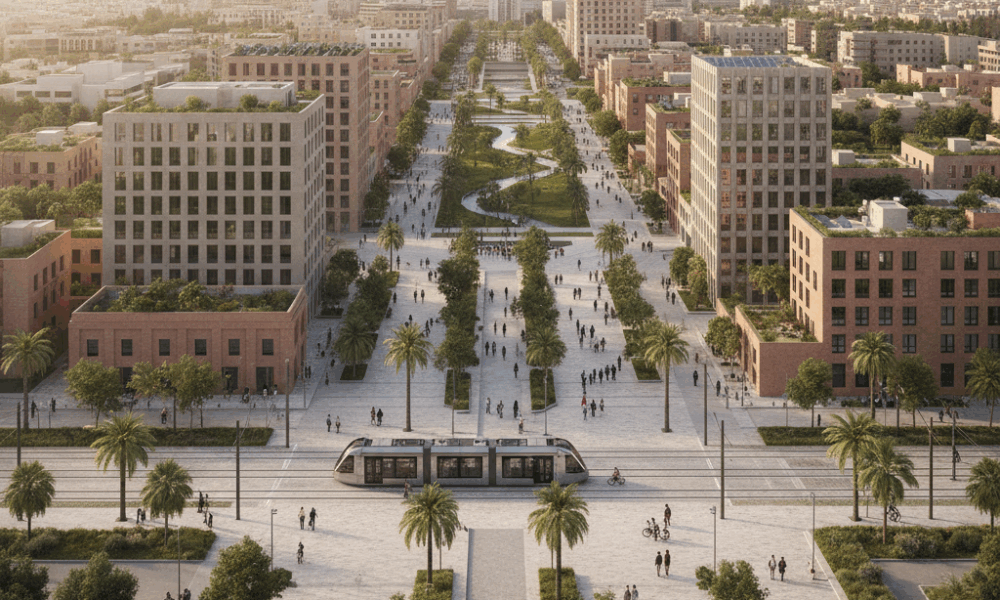
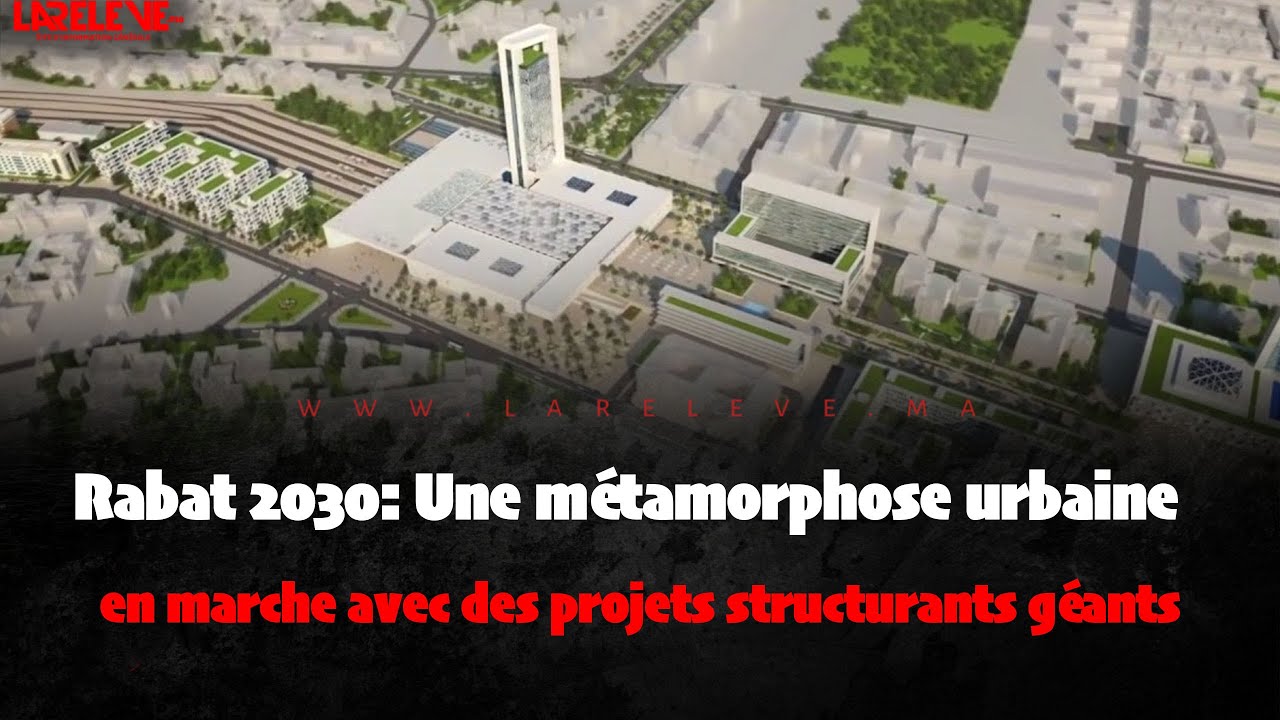
Société Rabat Région Aménagement accelerates a roadmap that redesigns the administrative capital around smoother mobility, renovated public spaces, and a better quality of life. The plan, officially approved and published in the Official Bulletin in February 2025, covers strategic neighborhoods such as Yaâcoub El-Mansour, Agdal-Ryad, Hassan, Youssoufia, and Souissi. The objective is twofold: to modernize the urban framework while strengthening the economic, cultural, and tourist attractiveness of Rabat. The announced projects fit within the vision of RabatEnMouvement and align with the ambitions of RabatSmartCity, consistent with international deadlines toward 2030.
The dynamic is based on nine recurring pillars in contemporary UrbanismeRabat: strengthening administrative functions, heritage rehabilitation, diversification of cultural offerings, development of tertiary sectors, upgrading commercial standards, innovation and knowledge, as well as protection of buffer zones for UNESCO-listed sites. In parallel, the creation of new roads, widening of key axes such as Mohammed VI Avenue, and integrated parking systems aim to relieve congestion and secure daily commutes.
Concrete Directions and Use Cases 2025
In the Youssoufia district, the widening of Mohammed VI Avenue smooths flows between residential neighborhoods and employment zones. In Souissi, connectivity improvements enhance service accessibility. At Place d’Italie, in the Ocean neighborhood, the construction of an underground parking lot frees up surface space for pedestrian and commercial uses. These technical interventions are accompanied by an expropriation scheme declared of public utility, requiring reinforced and transparent social monitoring.
- 🚧 Structuring Mobility: creation of inter-neighborhood links to reduce travel times and business logistics costs.
- 🌿 Public Spaces: redesign of squares and parks within the PlanVertRabat framework, with cooling islets and pedestrian paths.
- 🏛️ Heritage: protection of buffer zones to preserve the capital’s identity while supporting RabatEcoDéveloppement.
- 💼 Local Employment: contracts for work and services generating positions for craftsmen, technicians, and engineers.
- 📶 Digital: urban sensors, automated parking management, and flow control in the spirit of VilleFuturRabat.
This framework opens career perspectives in engineering, infrastructure maintenance, operational urban planning, and urban services. It is an opportunity for local construction and digital micro and small businesses, mobilized within local sectors.
| District 🏙️ | Priority Action 🔧 | Expected Effect ✅ | Keywords |
|---|---|---|---|
| Youssoufia | Widening of Mohammed VI Ave. | Decongestion and safety 🚦 | RabatAménagement, RégionRabat2025 |
| Souissi | New roads and signage | Access to service hubs 🏥 | UrbanismeRabat, RabatEnMouvement |
| Hassan | Urban redevelopment | Heritage enhancement 🏛️ | RabatEcoDéveloppement |
| Agdal-Ryad | Traffic optimization | Reduced travel time ⏱️ | VilleFuturRabat |
At the macro scale, the 2025 choices consolidate territorial competitiveness and create a solid base for urban innovation. The next section zooms in on daily mobility, which concentrates a large part of investments and jobs.
Mobility, Parking and Taxi Stations: Modernized Services, Employment and Quality of Life
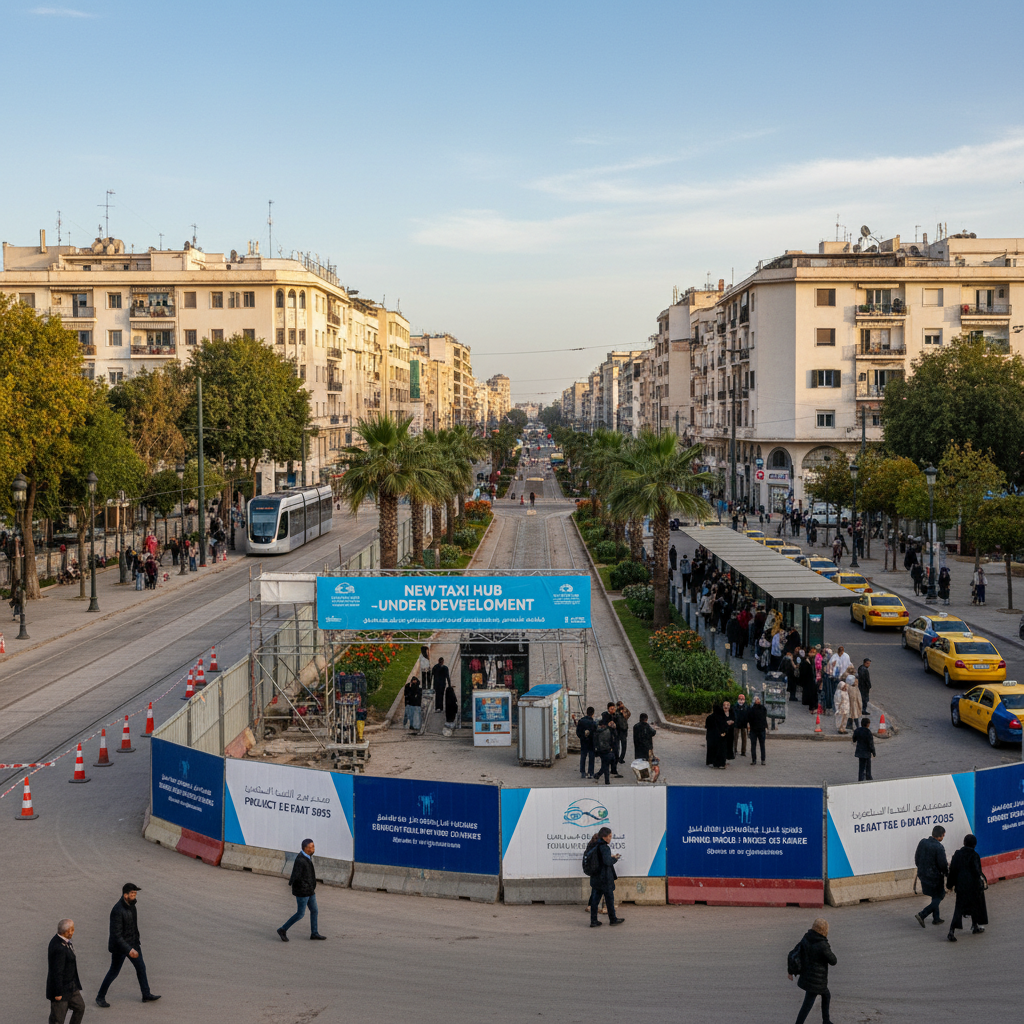
The modernization of mobility in Rabat relies on an announced investment for six taxi stations, estimated at approximately 140 million dirhams. Each site will benefit from optimized parking, restrooms, secured access, and an automated vehicle management system. This upgrade in service, led by the local public operator, aims to make journeys more predictable, secure users, and professionalize the sector. The modernization integrates with the future underground parking at Place d’Italie, in the Ocean neighborhood, designed to free up public space on the surface.
On the ground, diverse profiles are mobilized: drivers, controllers, reception agents, IoT technicians, station managers, and maintenance specialists. The digitalization of flows aligns with the ambition of InnovUrbaineRabat and facilitates real-time data to regulate queues, anticipate peaks, and coordinate with complementary transport.
Citizen Service and Urban Synchronization
Service regularity also depends on the daily needs of inhabitants. By integrating local benchmarks, managers improve planning. Applications can, for example, incorporate the prayer times in Fès to anticipate intercity demand peaks during weekends or high-traffic periods. The logic is to orchestrate an inclusive, accessible mobility respectful of social rhythms.
- 🚌 Modernized Stations: organized queues, real-time traveler information, comfortable waiting.
- ♿ Accessibility: clear pathways, ramps, clear signage.
- 📊 Performance Measurement: waiting times, occupancy rates, user satisfaction.
- 💼 Direct and Indirect Jobs: supervision, security, cleaning, micro-businesses.
- 🔌 Equipment: LED lighting, terminals, sensors, contactless solutions.
| Equipment 🚉 | Key Function 🔑 | User Benefit 😀 | Employment Impact 💼 |
|---|---|---|---|
| Taxi stations | Automated management | Reduced waiting ⏳ | Coordination agents + IoT tech 👩💻 |
| Place d’Italie parking | Surface liberation | Pedestrian spaces 🌳 | Maintenance & security 🔐 |
| Signage | Quick orientation | Usage comfort 🧭 | Design & installation 🧰 |
The mobility component becomes a catalyst for local employment and the capital’s brand image. At the national level, these investments connect to major corridors, including the feasibility study scenarios for the Morocco–Europe tunnel, inspiring an integrated network vision. Such projects reaffirm the ambition of AvenirUrbainRabat, creating metropolitan synergies.
Expropriations, Relocations and Social Dialogue: Managing Human and Legal Risks
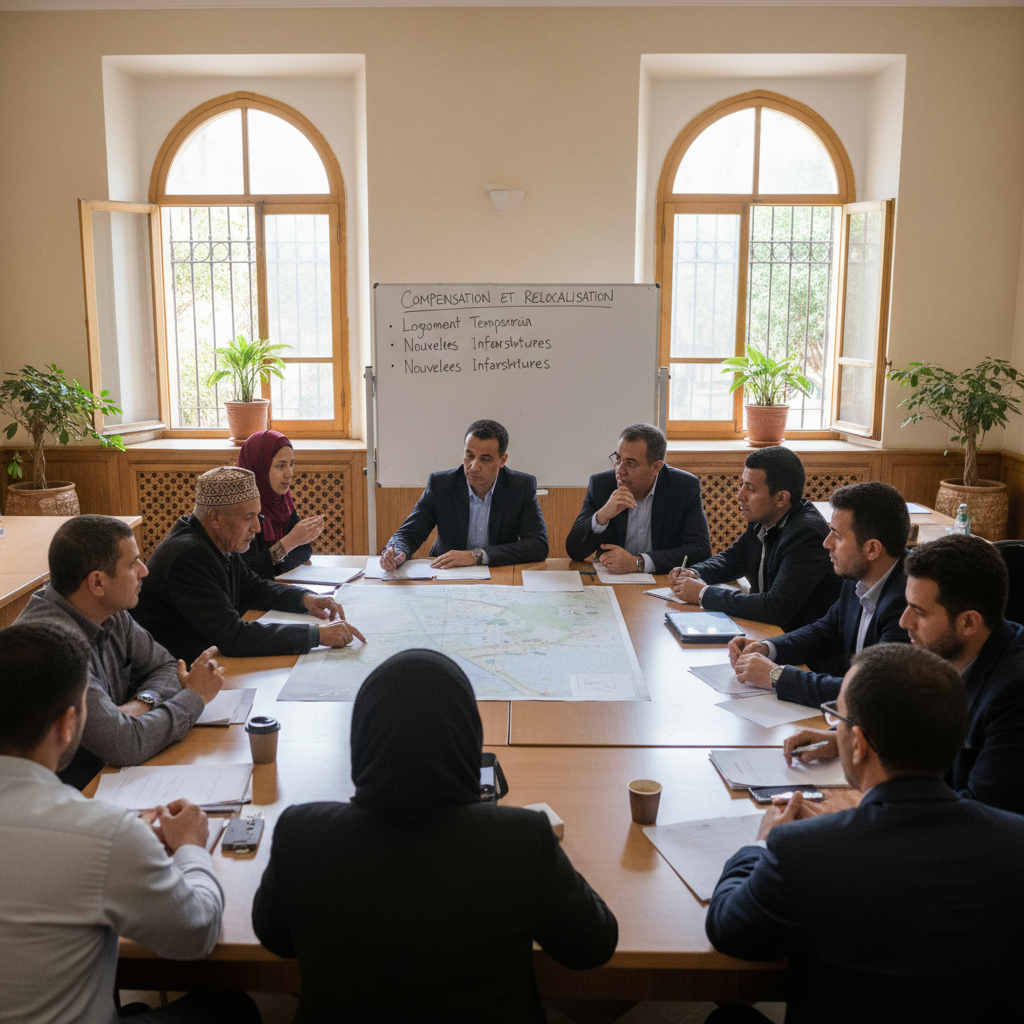
The success of major projects also plays out on the social ground. Accelerated expropriation procedures, triggered within the framework of the declaration of public utility, have caused disputes, notably in Yaâcoub El-Mansour, Agdal, and Hassan. For the affected households, it is not just about relocation but a uprooting: loss of landmarks, neighborhood networks, and local economic routines. The Democratic Left Federation has relayed protests, calling for strengthened consultation and compensation perceived as fair.
In a reference scenario, a family settled in Hassan for three generations receives a sudden notification. Without prior mediation, distrust settles in. Best practice consists of establishing a support desk, transparent heritage assessments, and relocation solutions adapted to jobs, schools, and household services. The challenge is to turn a crisis moment into a support journey, compatible with the pace of works.
Action Framework for Responsible Implementation
- 📑 Transparency: detailed schedule, compensation scales, independent mediation.
- 🏘️ Local Relocation: avoiding distance from workplaces and key services.
- 🧭 Social Guidance: administrative support, microcredits, mobility aids.
- ⚖️ Legal Compliance: respect of deadlines and justified information on decisions.
- 🤝 Consultation: co-design workshops with residents and economic actors.
| Step ⚙️ | Good Practice ✅ | Risk if Missing ⚠️ | Social Effect 🤲 |
|---|---|---|---|
| Notice & Information | Public meetings | Increased disputes 🧨 | Initial trust 🤝 |
| Assessment | Clear scale | Feelings of injustice 😟 | Acceptability 📈 |
| Relocation | Proximity & services | School/job disruption 🚫 | Life continuity 👨👩👧 |
To encourage acceptance, comparisons are useful. Debates around the considered trans-Mediterranean connection have shown how public utility can coexist with strong social guarantees. The key is to combine speed and fairness, so that RabatAménagement becomes synonymous with shared progress.
Digital and Sustainability: RabatSmartCity and PlanVertRabat Serving a Resilient City
Urban transformation is accompanied by a digital layer that improves maintenance, security, and citizen experience. Traffic sensors, energy meters, automated parking management, and urban dashboards enable continuous flow control. The RabatSmartCity ecosystem consolidates a data-driven governance, where air quality, noise, and public lighting are optimized at controlled costs. This strategy enhances attractiveness for talents and investors while fostering the emergence of local startups.
On the environmental level, the PlanVertRabat restores ecological continuities: alignment plantings, green corridors, shading, permeable soils, and integrated rainwater management. The goal is to limit heat islands and offer shaded pedestrian routes compatible with a warming climate. Developments prioritize durable materials and passive cooling solutions to reduce energy consumption.
Tech and Nature Solutions in the City
- 🌡️ Climate Monitoring: temperature and humidity sensors to adapt park maintenance.
- 🚦 Intelligent Traffic: adaptive lights and priority for public transport.
- 🔋 LED Lighting: reduced consumption and predictive maintenance.
- 🌳 Green Corridors: vegetated corridors for shaded walking and breathing.
- ♻️ Circular Economy: material reuse and spoil management.
| Solution 🌐 | Function 🎛️ | Gain 📈 | Horizon 🗓️ |
|---|---|---|---|
| Traffic sensors | Regulation | +20% estimated fluidity 🚗 | Short term |
| Smart LED | Adaptive brightness | -30% consumption ⚡ | Short term |
| Permeable soils | Infiltration | Less runoff 💧 | Medium term |
Major national corridors provide a reference framework: strategic reflection around the feasibility study of the Morocco–Europe tunnel nourishes a culture of integrated infrastructure, where intermodality and sustainability respond to each other. On a daily basis, these advances anchor RégionRabat2025 on a sober, competitive, and inclusive trajectory.
Projects and Local Employment: Skills, Markets and Opportunities for 2025
Urban developments generate a multiplier effect on employment and skills. Between public works, civil engineering, engineering, environment, security, and digital, the ecosystem is recruiting. Local companies – cooperatives, micro and small enterprises – benefit from positioning themselves on specialized packages, with an emphasis on quality, traceability, and safety. Clients value measurable performance and continuous training, conditions for a resilient AvenirUrbainRabat.
A guiding thread illustrates the challenge: a young team of engineers from Hay Riad launches a startup of sensors for connected parking lots. Offering modular and interoperable solutions, it lands a first pilot contract in a taxi station and extends its offer to predictive maintenance. This type of initiative, catalyzed by the needs of RabatAménagement, accelerates skill upgrading locally and creates qualified jobs.
Sought Profiles and Spillover Effects
- 👷 Public Works and VRD: site managers, pipeline workers, surveyors.
- 🧑💻 Data & IoT: system integrators, analysts, cybersecurity.
- 🌿 Landscape & Environment: green space technicians, water management.
- 🛡️ Security & Operations: access controllers, reception agents.
- 📐 Project Management & Engineering: BIM, modeling, costs and deadlines.
| Sector 🧭 | Key Skills 🧰 | Mission Example 📝 | Market Effect 💹 |
|---|---|---|---|
| Public works & civil engineering | Quality, safety | Network installation 🚧 | Boost local subcontracting |
| Urban IoT | Interoperability | Parking sensors 📶 | Demand for tech profiles |
| Green spaces | Efficient watering | Green corridors 🌿 | Maintenance contracts |
Internationally, comparisons sharpen the investment strategy: the study of investing in a farm in Brittany illustrates other sector and financing models, useful to diversify Moroccan expertise. Locally, these projects strengthen the value chain and feed the dynamic of RabatEcoDéveloppement.
Governance, Financing and Attractiveness: Making Rabat a Metropolitan Reference
Execution quality conditions overall attractiveness. Clear governance – steering committees, dashboards, audits – reassures investors and citizens. Financial arrangements combining local budgets, public-private partnerships, and targeted subsidies balance performance and sustainability. Within this framework, particular attention is paid to public procurement: lotting, innovative criteria, social and environmental clauses.
For recruiters, the 2025 projects serve as a showcase: ability to meet deadlines and costs, risk management and quality improvement. For young graduates, calls for tenders require mastering technical standards and collaborative software. Metropolitan credibility passes through visible deliverables – renovated taxi stations, fluid parks, comfortable public spaces – that support local commerce and service economy.
Focus on International and Territorial Coherence
Metropolitan ambitions rely on national and international corridors. The reflection around a considered trans-Mediterranean connection contributes to projecting the capital into regional value chains. In parallel, the study of an example of productive investment abroad illustrates the need to calibrate local impacts, so that the value created benefits employment and training in Morocco. In daily life, service synchronization – including cultural landmarks like prayer times in Fès – inspires more inclusive interfaces for the general public and transport professionals.
- 🧭 Governance: data-driven management, shared deadlines, accountability.
- 💶 Financing: budget mix, PPP, phased investments.
- 🌍 Influence: academic and industrial partnerships.
- 🪴 Sustainability: environmental criteria in contracts.
- 🧑🎓 Skills: continuous training and certifications.
| Lever 🏁 | Tool 🧩 | Indicator 🎯 | Employment Effect 👥 |
|---|---|---|---|
| Public procurement | Lotting | SME share 📊 | Wider market access |
| Innovation | Technical criteria | Patent/POC 🔬 | Upgrade in quality |
| Inclusion | Social clauses | Insertion hours ⏱️ | Jobs for youth |
This governance, supported by clear indicators, firmly establishes the territorial brand RégionRabat2025 and consolidates the VilleFuturRabat promise to citizens and investors.
{“@context”:”https://schema.org”,”@type”:”FAQPage”,”mainEntity”:[{“@type”:”Question”,”name”:”Which neighborhoods of Rabat are primarily concerned by the 2025 developments?”,”acceptedAnswer”:{“@type”:”Answer”,”text”:”Interventions focus on Yaâcoub El-Mansour, Agdal-Ryad, Hassan, Youssoufia, and Souissi, with axis widening, new roads, public space redevelopment, and improvement of daily mobility.”}},{“@type”:”Question”,”name”:”What is the impact on local employment?”,”acceptedAnswer”:{“@type”:”Answer”,”text”:”The projects generate jobs in public works, engineering, urban IoT, operations and maintenance. Local micro and small enterprises are encouraged to position themselves thanks to lotting and innovation clauses.”}},{“@type”:”Question”,”name”:”How are expropriations managed?”,”acceptedAnswer”:{“@type”:”Answer”,”text”:”They are part of the public utility declaration. Good practices are expected: complete information, transparent compensation rates, mediation, local relocation, and social support.”}},{“@type”:”Question”,”name”:”What do the modernized taxi stations bring?”,”acceptedAnswer”:{“@type”:”Answer”,”text”:”Organized queues, real-time information, secured access, restrooms, and automated management to reduce waiting and improve service quality.”}},{“@type”:”Question”,”name”:”How is the sustainability dimension integrated?”,”acceptedAnswer”:{“@type”:”Answer”,”text”:”PlanVertRabat relies on green corridors, permeable soils, LED lighting, and data-driven governance to limit environmental footprint and improve urban comfort.”}}]}Which neighborhoods of Rabat are primarily concerned by the 2025 developments?
Interventions focus on Yaâcoub El-Mansour, Agdal-Ryad, Hassan, Youssoufia, and Souissi, with axis widening, new roads, public space redevelopment, and improvement of daily mobility.
What is the impact on local employment?
The projects generate jobs in public works, engineering, urban IoT, operations and maintenance. Local micro and small enterprises are encouraged to position themselves thanks to lotting and innovation clauses.
How are expropriations managed?
They are part of the public utility declaration. Good practices are expected: complete information, transparent compensation rates, mediation, local relocation, and social support.
What do the modernized taxi stations bring?
Organized queues, real-time information, secured access, restrooms, and automated management to reduce waiting and improve service quality.
How is the sustainability dimension integrated?
PlanVertRabat relies on green corridors, permeable soils, LED lighting, and data-driven governance to limit environmental footprint and improve urban comfort.

Comments are closed