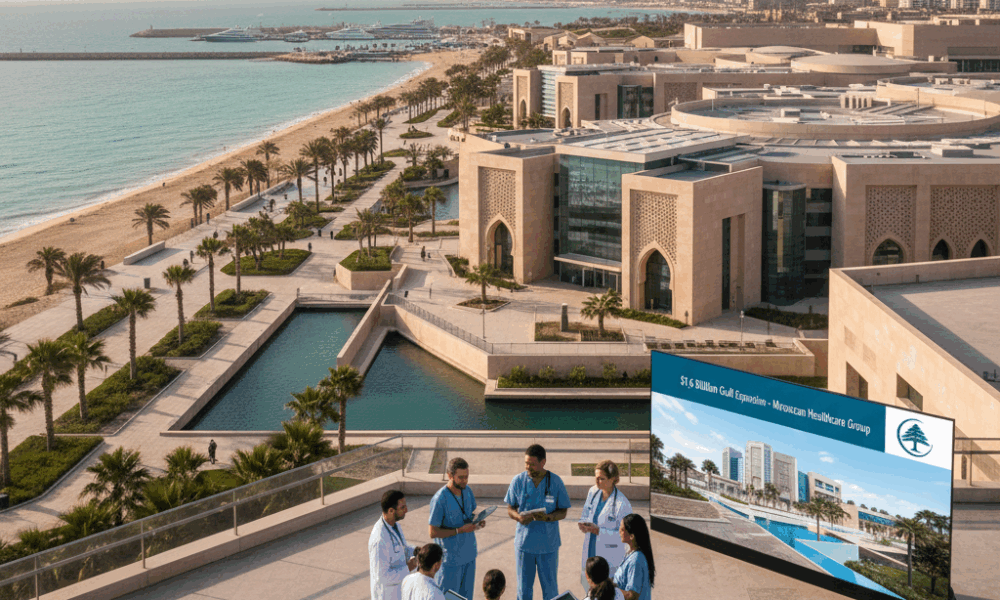
$1.6 Billion Expansion in the Gulf: Moroccan Jobs and Value Chains
A Moroccan healthcare giant is preparing an ambitious $1.6 billion expansion in the Gulf, with an industrial plan designed to maximize spillover effects in Morocco. The goal is twofold: to seize the momentum of the Gulf market and strengthen national sectors — biomedical engineering, maintenance, training, and IT support — capable of exporting their expertise. In 2025, the timing is favorable: the demand for premium healthcare accelerates in the region, and the qualified Moroccan workforce combines controlled costs with a service culture.
The operational plan is based on phased waves. First, specialized clinics in critical care and maternity in the UAE and Saudi Arabia. Then, outpatient and rehabilitation centers in Qatar and Bahrain. Finally, telemedicine hubs interconnected with technical platforms in Morocco to optimize expertise use and imaging platforms. This model creates direct jobs in the Gulf while consolidating skilled positions at home for imaging, HR back-office, hospital analytics, and procurement.
Jobs, Mobility, and Skills Development
The impacts on Moroccan employment are concrete. The scale-up requires specialized nurses, biomedical technicians, patient pathway managers, international billing agents, and quality managers. Career pathways are structured in a “round-trip” fashion: some staff undertake 6 to 18-month assignments in the Gulf, return to Morocco to transfer practices and standardize protocols. To illustrate this trend, the growth in nurse recruitment shows how demand exceeds the borders of major urban centers.
Mobility is supported by airlines and smooth logistics. The employment dynamics linked to air transport help secure staff rotations and on-site continuous training, as confirmed by initiatives for job development in aviation. On the financing side, the Moroccan banking ecosystem strengthens support for international groups, with specialized professions, reflecting the corporate advisory expertise deployed by networks of bank advisors in Casablanca.
- 🩺 Strengthening clinical professions (IADE, IBODE nurses, emergency doctors) with certification pathways.
- 🛠️ Deployment of biomedical maintenance teams based in Morocco and rotating in the Gulf.
- 🧮 Structuring hospital analytics to optimize patient flows and international billing.
- 🌐 Digital hubs in Morocco for telemedicine and diagnostic assistance.
- ✈️ Circular mobility to capitalize on experience and stabilize teams long-term.
For the supply chain, the ambition is to reach 35% of outsourced purchases and services from Morocco, leveraging the local engineering pool, including technological partners such as engineering teams based in Morocco. This lever anchors value domestically and protects margins in a competitive environment.
| Target Country 🌍 | Estimated Capex 💸 | Direct Jobs (Gulf) 👷 | Moroccan Jobs (support) 🧑💻 | Phase ⏱️ |
|---|---|---|---|---|
| UAE | $400M | 1,200 | 800 | 2025-2027 |
| Saudi Arabia | $700M | 2,000 | 1,100 | 2025-2028 |
| Qatar | $250M | 650 | 450 | 2026-2028 |
| Bahrain | $150M | 420 | 300 | 2026-2027 |
| Oman | $100M | 260 | 200 | 2027 |
In the short term, the key will be fine skills planning and securing medical supervision. This momentum transforms the Moroccan presence into a true structuring international development.

Economic Model and Partnerships for Success in the Gulf Market
The viability of this expansion relies on a hybrid economic model combining heavy investments and operational efficiency. Private health insurance contracts dominate in several Gulf market countries, but public-private partnerships (PPP) are gaining ground, notably in Saudi Arabia. For the Moroccan healthcare giant, the strategy is to combine highly specialized establishments with outpatient centers with shorter amortization cycles.
The Capex/Opex structure is calibrated with targeted margins of 14-18% for hospital services and 10-12% for outpatient care. Managing the total cost of ownership (TCO) of equipment is critical: imaging, robotic surgery, and central sterilization require controlled renewal cycles. Here, Morocco’s industrialization experience is an asset, exemplified by engineering and supply chain projects proven efficient, such as those developed by engineering players like automotive engineering centers in Rabat and Casablanca or aeronautical skills capitalized via the aircraft engines center.
Joint Ventures, PPPs, and Collective Purchasing
The core of the partnerships focuses on three levers. First, joint ventures with local investors to accelerate access to land, permits, and insurer networks. Second, PPPs to delegate certain units (imaging, dialysis) with quality commitments and risk-sharing clauses. Finally, collective purchasing for consumables, medical devices, and medicines to capture volume discounts and stabilize prices.
To smooth revenue seasonality, the offer integrates prevention, rehabilitation, and occupational health. An instructive parallel can be drawn with the resilience of other Moroccan export sectors, including agro-industry, which optimized their flows despite uncertainties, as seen in the citrus sector, with trends mentioned around a record lemon export. This culture of logistical performance inspires the standardization of hospital flows.
- 🤝 Local joint ventures to share risks and accelerate establishment.
- 🏥 Targeted PPPs (imaging, dialysis, emergency) to optimize capital allocation.
- 📦 Collective purchases and framework contracts to stabilize procurement costs.
- 📈 Value-based pricing and clinical indicators integrated into billing.
- 🌱 Sustainable development: energy efficiency and consumables reduction.
Morocco dedicates on average nearly 6% of its GDP to health, a level lower than OECD countries (around 9%) and WHO benchmarks (10-12%). This budget constraint has stimulated managerial ingenuity and quality discipline, useful for operating in competitive environments. At the macro level, North-South and South-South cross-capital flows multiply, confirming the vigor of flows, akin to implantation projects in Europe recently mentioned around cross-border investments. Similarly, national logistics corridors are expanding, strengthening Morocco’s capacity to export high-skill hospital services.
| Revenue Source 💳 | Expected Share (%) 📊 | Target Operating Margin 🧮 | Main Risk ⚠️ | Strategic Response 🛡️ |
|---|---|---|---|---|
| Private insurers | 45-55 | 16-18% | Price pressure | Value contracts and KPIs 🎯 |
| International patients | 10-15 | 15-17% | Flow volatility | Premium offer + packages ✈️ |
| Employers/PPP | 20-25 | 14-16% | Contractual risk | Risk-sharing clauses 🤝 |
| Outpatient | 15-20 | 10-12% | Season & act mix | Planning optimization 📅 |
Sector comparisons show that large infrastructure projects — reminiscent by size of tenders like the $1.6 billion railway project — require tight governance and quarterly milestones. A similar logic will apply here to maintain the ambition of an additional $1.6 billion if demand justifies it. Financial robustness relies on local expertise and on setting up investment committees. To track the regional dynamic, consult territorial analyses, especially those related to economic development of the southern regions.

The next step will concern the preparation and availability of talents to operate these high-exigency economic models.
Skills, Training, and Mobility of Health Talents
Success depends on human capital. The HR architecture foresees skills hubs, an “academy” model, and certification pathways. Priorities include anesthesia-resuscitation, emergency, perinatal care, oncology, hospital pharmacy, sterilization, and heavy equipment operation. To support the effort, universities and partners mobilize, like campuses investing in university hospitals and simulation platforms, a step echoing infrastructure financing initiatives in healthcare.
Talent mobility is designed inclusively. Professionals from across the Kingdom’s regions should benefit from skills upgrading programs, with short stays in the Gulf to master new protocols. HR logistics also incorporates daily life: housing, schools, insurance coverage, and purchasing power. In this regard, the compensation structure can combine salary, international bonuses, and benefits in kind, positively influencing mobility decisions.
Recruit Quickly, Train Correctly, Retain
Recruitment channels intensify. Sector campaigns target caregivers, but also non-clinical functions (IT, procurement, finance). The local economic fabric shows availability of actors capable of accelerating thematic recruitments, as observed in other sectors with recruitment campaigns or the rise of technical talent recruitment programs. Career management relies on a network of schools and institutes, with simulation modules and intra-group mentoring.
Attractiveness is also supported by the living ecosystem. Mobility incentives can include travel services, an adapted leave policy, and relocation assistance. A dynamic of healthy consumption upon return home can strengthen loyalty, including through benefits improving family mobility, such as facilitated access to automobiles, a topic closely followed by the public via market benchmarks such as popular vehicle prices.
- 🎓 Internal academy with clinical and non-clinical modules, simulation & mentoring.
- 🧭 “Round-trip” Gulf-Morocco pathways to disseminate best practices.
- 🧰 Targeted certifications (IBODE, IADE, radioprotection, sterilization).
- 🤝 University partnerships and paid internships.
- 💼 HR benefits: mobility bonuses, family support, continuous training.
| Profile 🎯 | Key Certification 🧾 | Training Duration ⏳ | Initial Assignment 🌐 | Evolution 12-24 months 🚀 |
|---|---|---|---|---|
| Anesthesia Nurse | IADE | 9-12 months | UAE/KSA Operating Rooms | Team Leader/Supervisor |
| Biomedical Technician | ISO 13485 | 6-9 months | Gulf Maintenance | Workshop Manager |
| Hospital Pharmacist | Quality & GxP | 6 months | Qatar/Bahrain | Pharmaceutical Coordination |
| Health Data Analyst | HIPAA/GDPR | 4-6 months | Morocco Hub | Analytics Lead |
By combining recruitment, training, and living conditions, the talent strategy transforms the expansion into a career ladder for professionals in the Moroccan hospital sector.

Quality, Accreditations, and Clinical Innovations for a Solid International Development
International credibility is based on a discipline of quality and recognized accreditations (JCI, ISO 15189, ISO 9001). Morocco has consolidated structuring approaches within hospitals, establishing scientific committees and good practice benchmarks. Recent years’ feedback — including the health crisis period — accelerated the standardization of triage, hygiene, and infectious risk management protocols. These achievements serve as a springboard for deployment in the Gulf market.
Innovation covers both care and organization. Telemedicine and electronic medical records roll out under a multi-site logic. The Moroccan hospital analytics hub provides near real-time performance dashboards: occupancy rates, emergency department wait times, avoidable complications. Software engineering, supported by specialized local teams, accelerates this digital transition and can rely on flexible technological know-how provided by engineering players such as tech teams based in Morocco.
Accreditation Roadmap and Clinical Performance
The roadmap is structured into three levels. Level 1: align clinical governance (antibiotherapy committees, medication safety, hygiene audits). Level 2: digitize critical processes (connected prescriptions, device traceability, sterilization). Level 3: aim for JCI certification with biannual mock audits. Each Gulf site benefits from support from a “center of excellence” based in Morocco, ensuring documentary coherence and skills maintenance.
The culture of continuous improvement relies on monthly indicator reviews, corrective action plans, and shared feedback via videoconferencing. This dynamic also spreads to growing Moroccan territories, aligned with territorial development agendas like those promoted for the Tanger-Assilah region towards 2025, supporting the emergence of advanced service ecosystems.
- 🧪 Patient safety at the center: AEIs, M&Ms, surgical checklists.
- 📊 Shared clinical dashboards and transparency of results.
- 🧼 Standardized hospital hygiene and fight against healthcare-associated infections.
- 🖥️ Electronic patient record, act traceability, and auditability.
- 🏅 International accreditations to gain payers’ trust.
| Quality Aspect ✅ | Key Indicator 🔎 | 12-month Target 🎯 | Support Tool 🧰 | Expected Gains 💡 |
|---|---|---|---|---|
| Hygiene & HAIs | HAI Rate | -25% | Audit & Training | Fewer complications 😊 |
| Operating Room | OTIF Surgery | +15% | Checklist & Lean | Increased productivity 📈 |
| Medications | Medication incidents | -30% | PDA & alerts | Patient safety 🛡️ |
| Customer Service | NPS | +10 points | CRM & Training | Loyalty 🤝 |
By capitalizing on these standards, the quality promise becomes a decisive competitive advantage for the group’s international development.
Procurement, Logistics, and Local Production Anchoring in Morocco
Operational performance relies on fine logistics, framework contracts, and local production anchoring. Flows of medical devices, medicines, and consumables require visibility and repeatability. The group sets up centralized purchasing, vendor-managed inventories, and regional warehouses. Moroccan coastal hubs serve as entry points and consolidation centers before redistribution to Gulf sites.
Cost and delivery time management draws on best industrial practices. Moroccan experience in logistics corridors and industrial integration proves valuable. Synergies with technical, energy, and IT players reinforce competitiveness. Young talent programs in energy and digital fields, visible through initiatives like Young Talents in Energy, feed these support functions.
Local Manufacturing, Maintenance, and Circular Economy
The ambition includes assembly and repair of non-critical equipment, shared sterilization, and valorization of certain consumable flows. The goal: reduce total operating costs by 12 to 18% in three years on major consumables (sterilization, gloves, infusion materials). Eco-design and predictive maintenance add to extend equipment lifespan, with a network of workshops managed from Morocco and interventions at Gulf sites.
Supply chain resilience depends on supplier diversification and alternative scenarios. Purchase schedules align with cash flow cycles of establishments. Structured payments and currency coverage limit exposure to volatility. Lessons learned from export sectors — including outside healthcare — inspire execution, as in agri-food or industry, where flow optimization is a competitive advantage.
- 🚚 Logistics hubs in Morocco with visibility on 90 days of critical stock.
- 🔧 Biomedical maintenance workshops and standardized spare parts.
- ♻️ Circular economy programs to reduce waste.
- 💹 Performance contracts with suppliers (bonuses/penalties).
- 🛰️ Digital traceability from batch to patient via codes and IoT.
| Supply Aspect 🏭 | Indicator 📏 | 18-month Target 🎯 | Lever 🔧 | Impact 💥 |
|---|---|---|---|---|
| Critical stocks | Coverage | 90 days | VMI/framework contracts | Fewer shortages ✅ |
| Transport | Hub→site time | -20% | Optimized routing | Responsiveness 🚀 |
| Consumable cost | €/act | -15% | Group purchasing | Margin + 📈 |
| Maintenance | MTBF | +25% | Predictive/IoT | Availability 🟢 |
This “Morocco-centric” logistics confers distinguishing agility and secures the pace of site openings in the Gulf.
Macroeconomic Effects and Benefits for Morocco
Beyond jobs, the investment projects macroeconomic gains: increased service exports, skill upgrading, diffusion of quality standards, and reshoring of high value-added segments. Exported healthcare services contribute to revenue diversification in foreign currencies, complementing other performant sectors structuring the trade balance.
At the territorial level, benefits manifest through training hubs, specialized providers, and incubators linked to e-health, with spillover effects in transforming urban ecosystems. Air corridors and connectivity support these skill exchanges, while regional dynamics, including in the South, are fueled by investment and infrastructure projects discussed in analyses on the economy of Sahara regions.
Outcome Indicators and Timeline
Quantifiable effects expected over three years include: 4,500 to 5,000 direct jobs in the Gulf, 2,800 to 3,500 support and engineering positions in Morocco, and an additional annual contribution of 0.1 to 0.2 percentage points to service exports. The timeline foresees staggered openings, with a faster ramp-up in outpatient care and longer delays for heavy services. Financing mechanisms mobilize debt, equity, and specialized banking solutions.
The Moroccan labor market emerges more resilient: international experience feeds career management, and the circulation of standards reflects back on the local care offer. Cross-sector transversalities — aviation, logistics, IT — amplify this impact. Useful link to follow career pathways, notably in aviation and staff mobility: career opportunities linked to air transport.
- 📊 Increase in health service exports and reinforced foreign currency revenues.
- 🧑⚕️ Accelerated skills upgrading and certification of key professions.
- 🏗️ Anchoring of biomedical workshops and digital hubs in Morocco.
- 🌍 Increased international notoriety, attractiveness for other FDI.
- 🧩 Spillover effects towards the local provider ecosystem.
| Macro Indicator 📈 | Base 2024 🗓️ | Target 2027 🎯 | Project Contribution 🧩 | Comment 📝 |
|---|---|---|---|---|
| Health service exports | Index 100 | Index 130 | +20 pts | Gulf as main relay 🌐 |
| Support jobs Morocco | — | 3,000 | 2,800-3,500 | Back-office & tech 🧑💻 |
| Localized purchase share | 20% | 35% | +15 pts | Workshops & framework contracts 🏭 |
| JCI accreditations | 0 | 3 sites | 3 | Progressive certification 🏅 |
Credibility gained opens further prospects: welcoming Gulf patients in Morocco for scheduled care, university agreements and R&D, and integration of “made in Morocco” digital solutions. Bridges with engineering, energy, and retail confirm market transversalities, as illustrated by talent initiatives and implantations already visible in the national ecosystem.

As sites open and teams stabilize, this trajectory transforms the investment into a lasting lever of national competitiveness.
{“@context”:”https://schema.org”,”@type”:”FAQPage”,”mainEntity”:[{“@type”:”Question”,”name”:”Quels mu00e9tiers seront le plus recrutu00e9s dans le cadre de lu2019expansion vers le Golfe ?”,”acceptedAnswer”:{“@type”:”Answer”,”text”:”Les prioritu00e9s portent sur les infirmiers spu00e9cialisu00e9s (IADE, IBODE), les urgentistes, les techniciens biomu00e9dicaux, la pharmacie hospitaliu00e8re, les data analysts santu00e9 et les fonctions support (achats, finance, IT). Des passerelles de mobilitu00e9 circulaire permettront aux talents formu00e9s au Maroc de ru00e9aliser des missions de 6 u00e0 18 mois dans le Golfe avant de revenir capitaliser leur expu00e9rience.”}},{“@type”:”Question”,”name”:”Quel est lu2019impact attendu sur les emplois au Maroc ?”,”acceptedAnswer”:{“@type”:”Answer”,”text”:”Outre les postes cru00e9u00e9s dans le Golfe, lu2019organisation pru00e9voit entre 2 800 et 3 500 emplois au Maroc dans les hubs digitaux, la maintenance biomu00e9dicale, la gestion de la qualitu00e9, lu2019analytique, la facturation internationale et les achats. Lu2019objectif est du2019atteindre 35 % du2019achats et services externalisu00e9s depuis le Maroc sur trois ans.”}},{“@type”:”Question”,”name”:”Comment sera financu00e9e lu2019enveloppe de 1,6 milliard de dollars ?”,”acceptedAnswer”:{“@type”:”Answer”,”text”:”Le financement combine capitaux propres, dette bancaire, partenariats public-privu00e9 et joint-ventures locales. Des solutions de conseil en financement du2019entreprise et de commerce international complu00e8tent le dispositif. En cas de montu00e9e de la demande, une extension additionnelle (parfois pru00e9sentu00e9e comme ,6 milliard de dollars de capacitu00e9) pourra u00eatre activu00e9e.”}},{“@type”:”Question”,”name”:”Quelles garanties de qualitu00e9 et de su00e9curitu00e9 pour les patients ?”,”acceptedAnswer”:{“@type”:”Answer”,”text”:”Chaque site du00e9ploie une feuille de route du2019accru00e9ditation (JCI, ISO), des comitu00e9s qualitu00e9, des audits ru00e9guliers et des indicateurs de performance (hygiu00e8ne, su00e9curitu00e9 mu00e9dicamenteuse, efficacitu00e9 au bloc). Les hubs marocains du2019analytique pilotent les tableaux de bord et assurent la cohu00e9rence documentaire.”}},{“@type”:”Question”,”name”:”Des opportunitu00e9s existent-elles pour les jeunes diplu00f4mu00e9s marocains ?”,”acceptedAnswer”:{“@type”:”Answer”,”text”:”Oui. Des acadu00e9mies internes, des stages ru00e9munu00e9ru00e9s et des programmes jeunes talents seront proposu00e9s, y compris pour les fonctions non cliniques (systu00e8mes du2019information, data, achats). Les candidats peuvent suivre lu2019actualitu00e9 des campagnes sectorielles et des programmes de talents visibles dans lu2019u00e9cosystu00e8me marocain.”}}]}Which professions will be the most recruited as part of the Gulf expansion?
Priorities focus on specialized nurses (IADE, IBODE), emergency doctors, biomedical technicians, hospital pharmacy, health data analysts, and support functions (procurement, finance, IT). Circular mobility pathways will allow talents trained in Morocco to undertake 6 to 18-month assignments in the Gulf before returning to capitalize on their experience.
What is the expected impact on employment in Morocco?
Besides the positions created in the Gulf, the organization foresees between 2,800 and 3,500 jobs in Morocco in digital hubs, biomedical maintenance, quality management, analytics, international billing, and procurement. The goal is to reach 35% of purchases and outsourced services from Morocco within three years.
How will the $1.6 billion envelope be financed?
Financing combines equity, bank debt, public-private partnerships, and local joint ventures. Corporate finance and international trade advisory solutions complement the setup. In case of increased demand, an additional extension (sometimes referred to as 0.6 billion dollars of capacity) may be activated.
What quality and safety guarantees are offered to patients?
Each site deploys an accreditation roadmap (JCI, ISO), quality committees, regular audits, and performance indicators (hygiene, medication safety, operating room efficiency). Moroccan analytics hubs manage dashboards and ensure documentary coherence.
Are there opportunities for young Moroccan graduates?
Yes. Internal academies, paid internships, and young talent programs will be offered, including for non-clinical functions (information systems, data, procurement). Candidates can follow updates on sector campaigns and talent programs visible in the Moroccan ecosystem.

Comments are closed